



Discussion
Assuming your orchid is getting the correct amount of sunlight for its genus, the second most important thing to consider is how much water it needs. This can vary between the genera and sometimes between the seasons of the year. It’s important to understand your orchid’s growth cycle to determine how much water it needs throughout the year.
Plants use the process of cellular respiration to break down stored carbohydrates for use in plant maintenance and blooming. A key component of cellular respiration is water. So, if your orchid is actively making more plant material or blooms, it will use more water. When the plant is resting or in a dormant phase, it will use less water. If you understand when your orchid needs less water, you can avoid overwatering. The AOS Care & Culture sheets that we talked about last month can help you with this.
The type of media you use will also affect how frequently you need to water your orchid. Bark and sphagnum moss make orchid media more water-retentive. For example, imagine you have two Phalaenopsis orchids. One is planted in a medium with bark and moss, one is not. These two plants will dry out at different rates. The one without the bark and moss will need to be watered more frequently. For this reason, it’s always a good idea to have plants in the same genus planted in the same type of media, as it makes watering easier.
When and how you water can be as important as how often you water. Overwatering occurs when you consistently provide more water than the plant can take in. This leaves water lying around the root system, which leads to decay and rotting. Generally, it’s best to water earlier in the day. The plant will photosynthesize during the day and take up the water for that process. There are two main ways you can water. First, you can pour water or run water from a spigot over the media and allow it to drain through, wait a few minutes, and repeat the process. Alternatively, fill a pitcher with water and an empty bucket. Hold the plant over the bucket, then water thoroughly, allowing the water to drain into the bucket. The key with both methods is allowing the pot to drain before putting it back in its saucer or decorative container. You never want to water an orchid while it’s in a decorative container that does not have a drain hole. This allows water to sit at the bottom of the container and rot the roots.
The type of water used is also a consideration. Most orchid genera will do fine with household tap water, rainwater, or bottled spring water. It’s not necessary to buy reverse osmosis (R/O) water. Household tap water cannot be used directly from the spigot if there is a “salt-based” water softener because the sodium these systems add to the water in removing hardness rapidly becomes toxic.
A final note about watering is that it is always best to water with tepid water – not too hot, not too cold. I would also be remiss if I didn’t address the “ice cube” watering technique. This is an amazing marketing idea that was intended to prevent overwatering. There are two main problems with this technique. First, Phalaenopsis orchids are from subtropical areas where they would never come in contact with ice in their native environments. The constant cold from the ice stresses the plant. Second, the salts dissolved in the ice slowly build up in the potting mix because there’s nothing flushing the potting medium.
Fun Fact
Orchid roots have evolved to store water in a sponge-like coating called velamen found around their roots. An actual orchid root is about the thickness of a fishing line, and it runs down the center of the velamen. This sponge coating is one of the reasons that orchids do not need to be watered as often as other houseplants. It’s also the main reason why overwatering can lead to the death of your orchid. Like any sponge, when the velamen sits in water from overwatering, it begins to break down and decay.
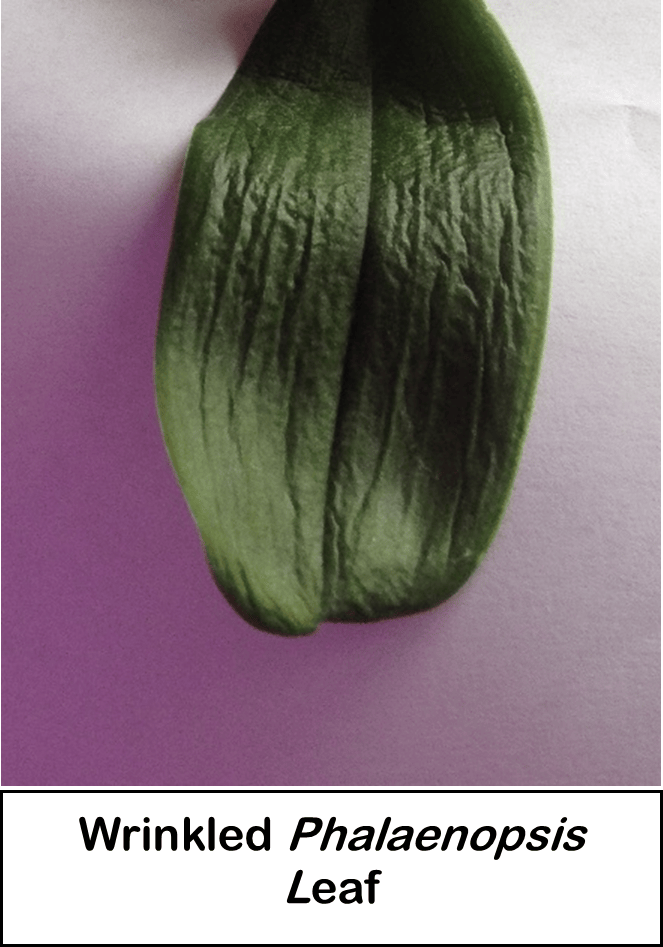
In the last lesson, we talked about how orchid leaves can tell you if the plant needs more or less light. These same leaves are not at all good at telling you if the plant has been overwatered or underwatered. Orchid leaves will wrinkle and become flaccid in either of those cases. This is because in either case, the root system has been damaged, and the plant can’t take in enough water. The only way to confirm what damage has occurred is to remove the plant from its pot. If the roots are black and mushy, the orchid was overwatered. If the roots are dry and falling apart, the orchid was underwatered. Healthy roots will be plump and firm to the touch.
Overwatering or underwatering does not necessarily mean your orchid will die. Once you have it out of the pot, clean out the dead roots. If the roots are decayed, gently wash the remaining roots in warm water. Either use a new pot or clean and disinfect the old pot before repotting. Use new media and repot the orchid. If you have lost a significant amount of the roots, you will have to water more frequently until new roots grow. Finally, wrinkled leaves will not become “unwrinkled,” but new leaves should look normal.
Website Tip
Your AOS membership gives you access to over 100,000 photos of award-winning orchids, as well as plant data, which includes in-depth genealogy (parents, family trees, species makeup, progeny). This is all available in our OrchidPro section of the website. The easiest way to access OrchidPro is to click on your name in the upper right side of the website home page. Then scroll down to OrchidPro.
Scroll to the bottom of the page to look at the most recently awarded plants. Thinking of buying a new orchid but want to know what it will look like? Type the genus/species/hybrid names in the boxes at the top and see photos of any awarded plants. Already have an awarded plant and want to see it again? Type the award number in the box at the top.
Resources
1. “Your First Orchid – Watering and Fertilizing” – Stephen Batchelor – American Orchid Society Bulletin, March 1993 - ORCHIDS Magazine
2. “Orchids for Everyone, General Orchid Care, Module 4 of the Master Gardener Orchid Series” – Webinar by Russ Vernon - Orchids for Everyone: General Orchid Care – Module 4 of the Master Gardener Series - American Orchid Society
3. Orchid Care tab – Basic Orchid Care – Watering Orchids - Watering - American Orchid Society
4. Orchid Pro Tutorial – Webinar by Laura Newton and Deb Bodei - https://www.aos.org/webinars/orchidpro-tutorial

FREE ACCESS: Orchid DealWire
Get notified when orchid vendors have special promotions and exclusive savings.