



Discussion
Do you know what the ideal temperature range for your orchid is? This will depend upon factors such as:
· Is it native to a tropical or sub-tropical climate?
· In the wild, does it grow at sea-level or high up in the mountains?
· Does it naturally grow in full sun or full shade?
· Does the orchid prefer a dry or humid environment?
Knowing the correct temperature range for your orchid is critical because plant metabolism is controlled by enzymes which function best within a set temperature range. Enzymatic activity will slow or even stop outside this ideal range which can lead to stunted plant growth. At the optimal temperature, these enzymes will:
· Make the process of plant respiration more efficient
· Speed up photosynthesis
· Improve nutrient uptake
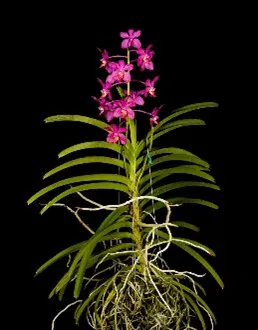
In general, most orchids will thrive between 55o F and 85 o F (18 oC and 29 oC). Some genera, such as Vanda, prefer the upper end of this range. TheVanda Suwannaphum Candy 'Eri's Orchid Paradise' shown in the picture on the left will grow best in a 70F-95F (21.1C-35C) daytime temperature range and 55F-72F (12.7C-22.2C) nighttime temperature range.
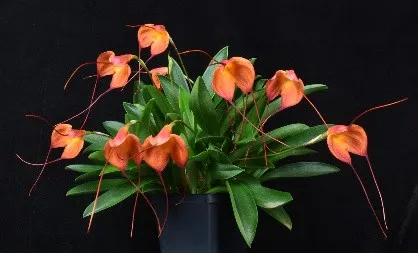
Other genera, such as Masdevallia, prefer the lower end of the ideal temperature range. The Masdevallia Cheryl Shohan 'J.A. P.' shown in the picture on the right prefers a consistent day/night temperature of 55F-72F (12.7C-22.2C).
Finally, if we are talking about temperature, we should also be talking about humidity as the two are very closely connected. This relationship is most evident in the process of transpiration which is where plants release water vapor through pores in their leaves called stomata. As the temperature rises, the process of transpiration increases, which speeds up the amount of water evaporating from the leaves. Left unchecked, the plant will dehydrate. However, if the plant is also in high humidity as the temperature rises, the process of transpiration will slow because the ambient air is already saturated with water vapor.
For example, most vanda orchids are native to locations with not only high average temperatures but also higher humidity.
Fun Fact
Have you ever wondered what tells your orchid to start blooming? Most of us are just thrilled that our orchids are blooming and never stop to ask “why?”. There are actually two main cues that tell an orchid that it’s time to produce blooms. One of those is temperature, and the other is daylength.
Most orchid genera have a preferred daytime temperature range and a somewhat cooler preferred nighttime temperature range. As the seasons move from summer to winter, the temperature differential between daytime and nighttime temperatures increases. It is this change in temperature differential that cues some orchids to begin producing blooms. Often it only requires a 1 or 2 degree increase in the temperature differential to start blooming. Phalaenopsis orchids are one of the genera that use this blooming cue. So, it’s important that your Phalaenopsis orchids are in a location in your home where they can sense the change in temperature around them.
Other orchid genera, such as Cattleya, are looking for shorter daylight hours to begin blooming. For some species of Cattleya, the decrease in daylight hours can be as small as 10 minutes each day. So, make sure that your Cattleya orchids are in a location where they can sense the shortening of daylight. Finally, many genera use a combination of both of the cues to begin blooming. Make sure you are aware of what your orchid needs to produce its blooms.
Website Tip
With over 880 different genera of orchids, it can become very difficult to keep them all straight. Taxonomy used to use Tribes, Subtribes and Alliances based on perceived genetic relationships. With molecular phylogeny, clades are now used, but these can sometimes be difficult to understand. The AOS has tried to maintain Alliances because they are easier to understand and are based on genetic relationships as determined from DNA analyses.
These 16 alliances can be found here: Orchid Alliances – American Orchid Society.
· Angraecum Alliance
· Bulbophyllum Alliance
· Catasetum Alliance
· Cattleya Alliance
· Coelogyne Alliance
· Cymbidium Alliance
· Dendrobium Alliance
· Maxillaria Alliance
· Oncidium Alliance
· Phalaenopsis Alliance
· Pleurothallis Alliance
· Slipper Alliance
· Stanhopea Alliance
· Vanda Alliance
· Zygopetalum Alliance
· Miscellaneous
Some of these names may sound familiar, and others may be totally new to you. Each alliance page provides a photo gallery, overview of the alliance, and links to any Care & Culture Sheets. Take some time to look through these alliances to see where your favorite orchids are.
Resources
· “Cold Tolerance of Warm Growing Orchids” - Sue Bottom – Orchids Magazine – December 2024 - 202412orch_93-12
· The American Orchid Society Guide to Orchids and their culture - Gerritsen, M. and Parsons, R., American Orchid Society – AOS Store - Products

FREE ACCESS: Orchid DealWire
Get notified when orchid vendors have special promotions and exclusive savings.