

There are only a few species in the following two sections. Both sections are endemic to the east coast of Australia. The plants of section Lichenastrum are all miniatures.
SECTION LICHENASTRUM
Dendrobium section Lichenastrum was first proposed as a genus by Brieger in 1981. Alick Dockrill reduced it to a section in 1992, in Australian Indigenous Orchids. The type species for the section is Dendrobium lichenastrum(F. Mueller) Krzl. There are three species in the section, all of which are endemic to Australia.
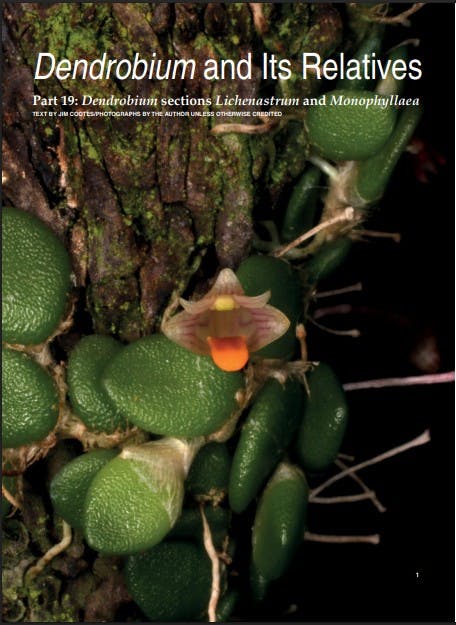
DENDROBIUM LICHENASTRUM First named as a Bulbophyllum species in 1869 by Ferdinand von Mueller, Fritz Kränzlin transferred it to the genus Dendrobium in 1910 in Das Pflanzenreich (The Plant Kingdom). The specific epithet refers to the resemblance of the foliage to a star lichen. The plants are mat-forming with thick oval leaves about ⅜ of an inch (1 cm) long. Inflorescences are single-flowered with the bloom being about ⅜ of an inch (1 cm) wide. This species is endemic to northern Australia, where it grows on both trees and rocks at sea level to about 3,900 feet (1,000 m) elevation.
[1] Dendrobium lichenastrum. Note the minutely pebbled leaf surface.
DENDROBIUM PRENTICEI This species, no considered by some to be a synonym of Dendrobium lichenastrum, was also first named as a Bulbophyllum species by Ferdinand von Mueller. William Nicholls transferred it to Dendrobium in 1938, in the North Queensland Naturalist. The specific epithet honors Dr. Charles Prentice, an Australian botanist. This is also a matforming species, but the leaves are terete, and point upward, reaching 1½ inches (4 cm) in length. Inflorescences are singleflowered, with the bloom being about ⅜ of an inch (1 cm) wide. This species is endemic to northern Queensland, Australia, where it grows on both trees and rocks at elevations from sea level to about 3,900 feet (1,000 m) elevation. Even though the flowers of this and the above species are almost identical, their very different leaf form and the fact they do not grow together in nature is enough, in my opinion, to keep them as separate species.
[2] Although the flowers of Dendrobium prenticei are very similar to those of Den. lichenastrum, the plants are quite different. The leaves of this species are longer and more pointed than those of Den. lichenastrum.
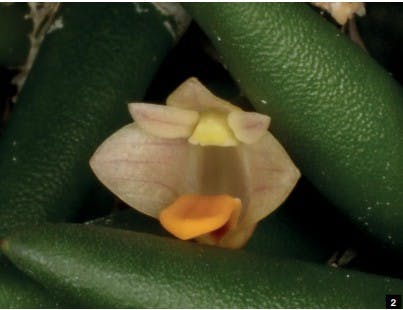
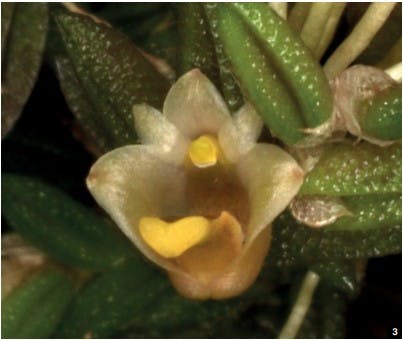
DENDROBIUM TORRESAE Frederick Bailey first named this orchid as a Bulbophyllum species, in 1889. Alick Dockrill transferred it to the genus Dendrobium in 1964 in The Orchadian, the journal of the Australasian Native Orchid Society. The specific epithet may refer to the Torres Strait, but I am unable to verify if this is correct. Also, a mat-forming species with leaves just ¼ of an inch (6 mm) long, with a warty surface. Flowers force their way between the closely packed leaves and are about ¼ of an inch (6 mm) in diameter. It is only known from northern Queensland, Australia, where it grows on both rocks and trees from sea level to 3,500 feet (1,060 m).
[3] The leaves of Dendrobium torresae are deeply channeled and almost terete.
SECTION MONOPHYLLAEA
This section was proposed by Bentham, in 1873, in Flora Australiensis: a description of the plants of the Australian territory. The type species for the section is Dendrobium monophyllum F. Mueller. There are three species in the section, all of which are endemic to Australia.
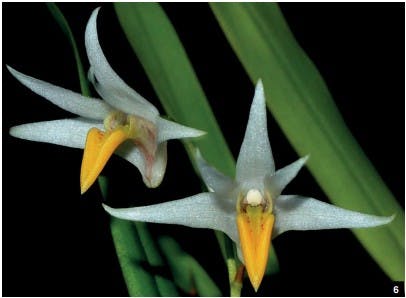
DENDROBIUM CARRII This species was named by Herman Rupp and Cyril White in 1937, in the Queensland Naturalist. The specific epithet honors Mr. T. Carr, collector of the first plants described. The plant is short growing with a thick rhizome where the pseudobulbs are spaced at intervals of up to 2 inches (5 cm). The inflorescence can reach lengths of 4 inches (10 cm) bearing up to 10 flowers about ⅜ of an inch (1 cm) in diameter. Endemic to the east coast of Queensland, Australia, it grows as an epiphyte at elevations of between 1,600 and 5,300 feet (500 to 1,600 m).
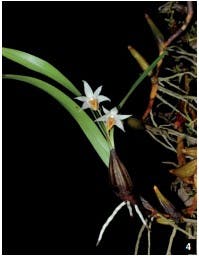
[4] Dendrobium carrii, illustrating the plant and flowering habit. Grown and photographed by Mike Harrison.
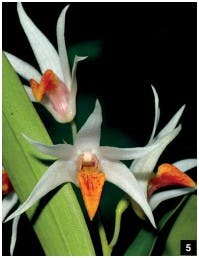
[5–6] Two different cultivars of Dendrobium carrii grown and photographed by Mike Harrison. The lip of this species varies from bright orange [5] to yellow [6].
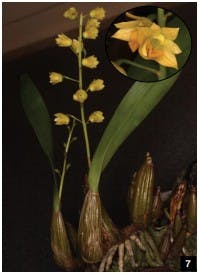
DENDROBIUM MONOPHYLLUM Ferdinand Mueller named this species in 1859, in Fragmenta Phytographiae Australiae (Fragments of Australian Phytography). The specific epithet refers to the single-leafed pseudobulb. The plant is short growing, with a thick rhizome where the pseudobulbs are spaced at intervals of up to 4 inches (10 cm). The inflorescence can reach lengths of 7 inches (17.5 cm) bearing numerous, sweetly fragrant flowers about ⅜ of an inch (1 cm) in diameter. Endemic to the east coast of Australia, it grows as an epiphyte at elevations up to 2,000 feet (600 m).
[7] Growth and flowering habit of Dendrobium monophyllum
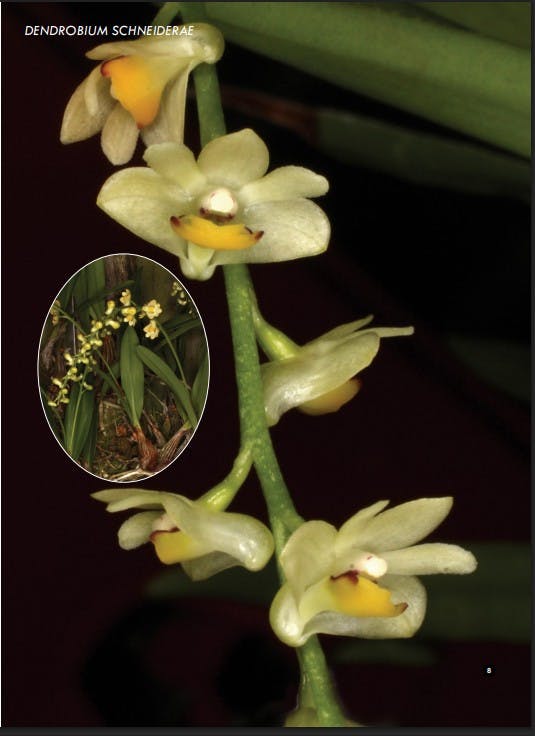
DENDROBIUM SCHNEIDERAE Named by Frederick Bailey in 1888, in Occasional Papers on the Queensland Flora, the specific epithet honors a Miss or Mrs. Schneider. Pseudobulbs are clumping and reach about 1 inch (2.5 cm) in height and carry two leathery leaves. The inflorescence can reach lengths of 7 inches (17.5 cm) bearing numerous, sweetly fragrant flowers about ¼ of an inch (6 mm) in diameter. Endemic to the east coast of Australia, it grows as an epiphyte at elevations of between to 400 and 6,000 feet (100 and 1,500 m).
[8] Dendrobium schneiderae is very similar but the insert photograph clearly shows this species’ bifoliate pseudobulbs.
— Jim Cootes has grown orchids for almost 50 years. He specializes in species orchids of Australia and Asia, particularly those of the Philippines. Mr. Cootes has written three books on Philippines orchid species and has also written countless articles, both scientific and of a more general nature that have been published worldwide. He lives in Sydney, Australia, where he keeps a small collection of orchids (email jimcootes@gmail.com).
Acknowledgments
Thanks to Mike Harrison (Australia), for the use of his pictures, to help enhance this article.
References
Dockrill A.W. 1969. Australian Indigenous Orchids. The Society For Growing Australian Plants. Parsons R. and M.E. Gerritsen. 2021. A Compendium of Miniature Orchid Species volume 2, Second Edition. Redfern Natural History Productions.