

That seems like an odd subject for an article, does it not? Of course we water our orchids. How basic can you get? However, the reason it is worth discussing is that the quality of the water one uses to irrigate one’s orchids can make a tremendous difference in the plants’ appearance and vitality. Whenever I analyze aspects of my own culture, I start by assessing the conditions the plants are likely to see in the wild and compare those to the level of “abuse” I give them in captivity. In the forests and savannahs from which our plants originate, their water sources are rain, fog or dew. In all cases, the liquid condenses from water vapor in the air, making them, in essence, nature’s version of distilled water. Rain that cascades down through the forest canopy picks up and carries nutrients to the orchids, but they tend to be in very small concentrations — on the order of 10–25 parts per million of total dissolved solids. It seems logical, therefore, to assume that orchids have evolved to thrive in the environment of pure water and minimal food supplies, and that exposing them to conditions other than that could be counterproductive, if not downright detrimental to their health. Indeed, “hard” water — that with lots of dissolved solids — can give our plants a really dull appearance, not only due to those minerals coating the leaves, but because those dissolved minerals can interfere with the plants’ physiological processes as well. When fertilizer is added to water, the mineral concentration can be high enough to be physically damaging.
A great many commercial growers swear by the use of pure water in their irrigation and feeding regimens, and some growers claim that it is especially important for the successful culture of cool-growing, high-altitude species, many of which spend their natural lives almost constantly dripping from the fog that routinely envelops them.
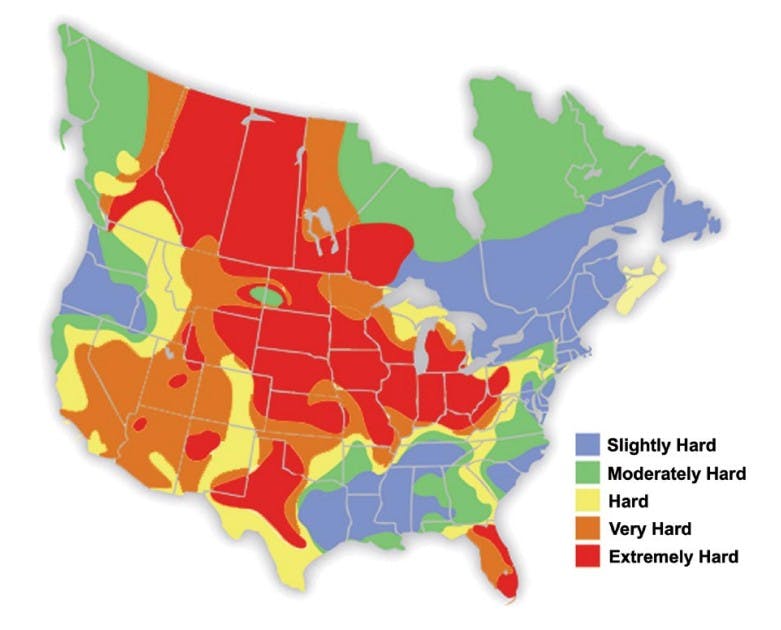
According to the United States Geological Survey, almost 90 percent of US homes have water that can be considered to be at least slightly hard, with Canada following closely behind at about 85 percent.
A word of caution: Do not rely entirely on this map to assess your water quality, as the treatment and selection of specific sources of water can have a significant effect on quality. For example, although parts of Colorado appear to have very hard groundwater according to the map, many municipalities rely heavily on snowmelt for their drinking water supply, and that is very pure. Likewise, New York City, whose water originates in wilderness watersheds, has some of the purest water around! The best thing you can do is ask your local water authority or have it tested.
Even though my well water is considered to be only “moderately hard,” being a bit of a “control freak” when it comes to my orchids, I prefer to use pure water and provide all mineral nutrients with my fertilizer, so that I know exactly what they are getting, without being subjected to the “whims” of nature.
There are a number of potential sources of pure water, so one must consider factors such as cost, availability, ease of use and environmental impact when deciding which source you will use for your plants.
Collected rainwater (or melted snow) is probably the least expensive source of pure water, but requires adequate storage capacity to carry you through dry spells or warmer seasons, and if you live in an urban or industrialized area, the air quality may render it less pure than we — or our plants — would like.
Air conditioner or dehumidifier condensate is again, a free, “distilled” source, but instead of waiting for nature to condense the moisture from the air as rain, we use a refrigerant to chill the air and force the condensation. This is a limited-volume source that is best utilized in warm, humid climates, but still needs tanks to store it, as most units only produce a trickle. Some warn against using these sources, as phytotoxic aluminum might be extracted from the heat exchanger “fins” (I have never heard of that being an issue, but forewarned is forearmed).
Distilled water is the purest possible and is produced by heating water to its boiling point so that it evaporates, leaving all of the dissolved solids behind, then cooling, condensing, and collecting that pure water for use. Many grocery stores and drugstores sell distilled water, but lugging it home can be a nuisance, and over time, especially with larger collections, can become quite costly. Some folks have their own “stills,” but they can be quite expensive to purchase, and unless they are solar powered, they can be expensive to operate, and in any case, will also require storage containers.
Deionized water is second only to distilled water in terms of purity and is produced by passing water through cylinders containing a variety of organic resins that extract and trap the dissolved mineral ions. If sized properly, these can be “on-demand” systems that are installed in-line with your plumbing to purify and supply the water as it is needed. Unfortunately, even though there typically is no need to purchase any equipment, and the on-demand pure water supply is very convenient, this method can become quite costly as the resin beds need to be recharged or replaced periodically by a professional (the harder your water, the more frequently this needs to be done).
Reverse osmosis (RO) water is the most common method of purifying water used by orchid growers. In an RO system, water is purified by passing it through a membrane having pores so small that they allow water molecules to pass while blocking as much as 99% of the dissolved ions. Like distilled, RO water can sometimes be purchased in stores, but having your own reverse osmosis system is usually the most cost-effective way of producing pure water, typically costing only a few pennies per gallon. Be aware that a residential system typically only delivers a few ounces per minute of pure water, necessitating some sort of storage tank for periodic irrigation with larger volumes, but they are usually set up to refill tanks automatically, so you always have a ready supply. Reverse osmosis systems also have a secondary water outlet — the “flush” water that carries away the rejected dissolved solids. Until recently, standard systems consumed four gallons of water to produce one gallon of pure water, with the other three being the flush water. Most folks use that flush water for less sensitive plants, let it trickle on the greenhouse floor for humidification, or, as in my own case, use it to refill an artificial pond outside the greenhouse, used by frogs and the local population of wild animals. If you pay for water and sewer fees based on your consumption, that can increase the costs somewhat, but modern systems use technology to reduce that ratio significantly.
Other sources of water simply do not provide the purity that is best for your plants:
Purified water can vary greatly in its chemistry but is most often simply passed through filters to remove sediment and dissolved organic compounds. No minerals are removed from the water. The filters that attach to your faucet or are inside special pitchers are in this category. They do provide an on-demand source of water and do not cost all that much but are of little value to the grower.
Spring water is just that — water that has been drawn from the underground aquifer and bottled for distribution. While it is lovely for drinking, it usually contains plenty of dissolved minerals, frequently more than the local tap water, making it taste great but offering no advantage for orchid growing.
Softened water has been passed through a chamber in which sodium chloride salt has been dissolved, causing the calcium, magnesium and iron carbonates — the “hardness” minerals — to settle out of solution. Do not use such softened water on your plants, as it can be toxic to them.
A final word on using pure water: Having no dissolved solids, pure water has no buffering capacity, that is, it has no resistance to large swings in solution pH upon the addition of chemicals such as fertilizers. The addition of even the smallest amount of most standard fertilizer formulas will result in solutions that are too acidic for use on the plants, necessitating some chemical adjustment. Fortunately,
several excellent formulas are designed specifically for use in pure water, such as the Greencare Orchid Special for RO (the original “MSU Fertilizer”), the K-Lite Orchid-Epiphyte Fertilizer derived from it, and Jack’s Professional Pure Water LX, to name a few.
Do not misconstrue this as suggesting that having pure water is the key to successful orchid growing. That is achieved by careful control of all of your cultural parameters (light levels, temperature, humidity, choice of media, watering and feeding), but once your plants have had a few weeks’ exposure to the pure water regimen, you will be happily surprised at their appearance and overall vitality.
— Ray Barkalow is an engineer and scientist and has been a hobby orchid grower for over 50 years. He has owned and operated First Rays Orchids since 1994 (email raybark@firstrays.com).