

I love bringing home new orchids. Sometimes I buy large plants in bloom but more often than not I bring home seedlings that I can watch grow up and bloom for me the first time.
SELECTING BLOOMING PLANTS You buy plants for any number of reasons: because you like the flower, you like the plant growth habit or you like the parentage and have great hopes for the future flower. If you are buying a plant in bloom, be sure to look beyond that gorgeous flower and take a careful look at the plant itself.
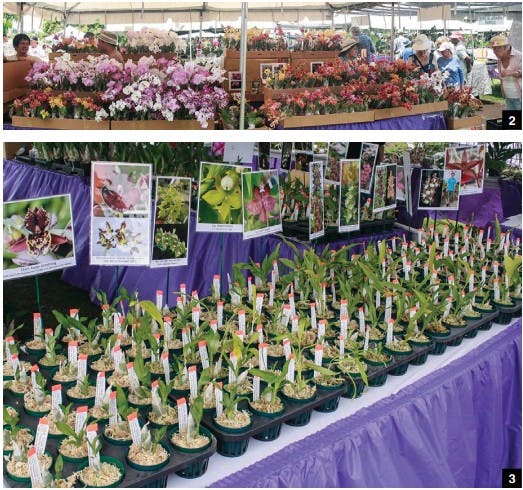
[1] Dreaming about what you might find at an orchid show? [2] Orchid Society shows and festivals are great opportunities to shop for orchids. Check out the AOS Show Calendar (https://www.aos.org/community-events) to find the next show in your area.

Healthy Root System. You know a healthy root system is the key to a plant that will bloom well for you. Any plant you buy should be fully established in the pot. Pick it up by its leaves or growths; the pot should lift with the plant. If the plant is wobbly in the pot, it is newly repotted and not established, or there is a problem with the roots and you will have to nurse it back to health.
[3] If you are selecting seedlings from a tray of similar seedlings, choose for vigor, the biggest pseudobulb, the widest and thickest leaf, etc. Then ask the orchid grower which one he thinks you should choose and why.
Fat and Happy Bulbs and Canes You’ll get the best blooms from plants that are vigorous growers. Look at the pseudobulbs or canes to see if they are plump, hard and full. If the bulbs are shriveled or wrinkled, the plant could be dehydrated from root problems or suffering from a disease such as Fusarium wilt.
Turgid and Unmarked Leaves Leaves should be full and hold themselves upright. Fleshy Phalaenopsis leaves should be thick and turgid, with no droopiness or other sign of dehydration. Mature Cattleya leaves should be hard with the texture of cardboard. Thinleaved orchids such as those of the Oncidiinae should be unwrinkled. The leaves should be a healthy green with no markings, except possibly for the reddish pigmentation that happens when orchids are grown in very bright light. Yellow, brown or black markings or edges may be indicative of a bacterial or fungal disease. Do not be overly concerned if there is an occasional blemish on the plant if it otherwise looks happy and healthy.
Absence of Pests and Diseases You want a plant that is pest-free. Check the base of the plant, in leaf axils and other hidden spots and make sure there are no scale, mealybugs or other crawling insects present. A diseased orchid may have yellow or black spotting, shriveling, soft spots or other blemishes, all of which should flash a warning sign to you when you are selecting a plant to bring home. If in flower, make sure there is no color break in the flower that can be a sign of virus.
Seedlings and Near-Blooming-Size Plants Seedlings are fun to bring home because you can spend hours imagining what the bloom might look like when it finally opens. If you are selecting a plant from a seedling tray, look for the one with the thickest bulbs and leaves. I often ask the orchid grower which seedling he would select and why; you’ll get lots of interesting insights this way. One grower said to choose a plant that had not yet bloomed, under the assumption that if it had bloomed and had a great flower, that plant would no longer be for sale.
[4] Don’t bring scale or other problems home to your growing area.
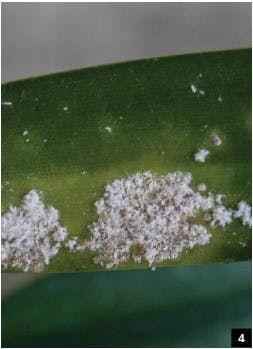
BRINGING NEW PLANTS HOME If you grow cattleyas, scale is your archenemy. After many years of battling scale, the growth inhibitor Distance (it is not cheap!) finally allowed me to declare the greenhouse a scale-free zone. Imagine my surprise when I noticed scale emerging on some of the new plants I brought home. They appeared clean when I selected them, but several months later I noticed the telltale chlorotic spotting and white patches. Clearly scale were lurking under the rhizome, dried sheathing bracts or the roots of my new plants.
The books all tell you to isolate plants for several months when you bring them into your growing area so you can catch problems without spreading them to the rest of your collection. I find I can’t resist the urge to group plants together as soon as I bring them home, new phals with old phals, new cattleyas with old cattleyas, etc., so the plants all get the proper light and water. I obviously needed a better plan for handling new orchids
Apply a Protective Drench Once you get home and before you introduce your new plant to the growing area, apply a protective drench through the potting media. A variety of pesticides contain the active ingredient imidacloprid, a systemic insecticide that can be introduced to the plant via the roots and absorbed throughout the plant. It will kill scale, mealybugs, etc. from the inside out without your having to spray it on leaf surfaces like you would a contact pesticide. Imidacloprid-bearing pesticides come in a wide variety of strengths. If you have an insecticide that contains 0.47% imidacloprid, add 3 ounces (89 mL) to a gallon (3.785 L) of water (23 mg/L) and pour it through the pot to thoroughly drench the growing media (1 oz/gal [8mL/L] for the 1.47% strength, 2 oz/gal [16 mL/L] for the 0.74% strength, etc.). The Bayer 3-in-1 product also contains a systemic miticide for residual control of spider mites as well as a systemic fungicide, although this particular fungicide may not offer much protection against common orchid diseases. There are better protective fungicidal drenches, such as Banrot or Subdue, available from specialty horticultural outlets albeit at a fairly expensive price.
[5] After you find an orchid that you just cannot live without, take a moment to inspect the plant to make sure it is healthy so you will still love it in the morning.

Repot into Your Mix of Choice If you bought a plant in bloom, let it bloom out and then repot it in your mix of choice. If it’s a seedling orchid, you may want to repot immediately upon bringing it home. This way you won’t have a hodgepodge of plants in sphagnum, bark and whatever else that all require watering at a different frequency. The only caveats are to try not to repot in the fall when plants are going into their winter rest and to be careful not to repot bifoliate cattleyas unless you see the initiation of new root growth. It is best to repot when new roots are just beginning to emerge because the plant will reestablish the most quickly when it is in a period of active root growth.
A new orchid should be a welcome addition to your collection, not a problem waiting to happen. Develop a system to make sure that your new beauty will live to bloom again along with all your old favorites.
— Sue Bottom started growing orchids in Houston in the mid-1990s after her husband Terry built her first greenhouse. They settled into St. Augustine, Florida, Sue with her orchids and Terry with his camera and are active in the St. Augustine Orchid Society, maintaining the society’s website and publishing its monthly newsletter. Sue is also a member of the AOS Publication Committee (sbottom15@bellsouth.net).