

As a plant lover for almost my entire 70+ years, I have accumulated several hundred houseplants, orchids and carnivorous plants. During the fall, winter and spring, they lived inside on the windowsills,
hanging hooks and a year-round porch, and then most were moved outside to the yard for the summer. As the collection continued to grow, they not only outgrew the inside, but the process of watering and transferring them in and out became unmanageable. About eight years ago, I decided to invest in a stand-alone greenhouse and purchased an 8-foot × 12-foot (2.44 m × 3.66m) cedar-and-double-polycarbonate model from a local supplier. After preparing a sand pad and a concrete block base with a pressure-treated frame, the site was ready for the greenhouse. I have since expanded it with a 4-foot × 8-foot (1.22 m × 2.44 m) addition.
[1–2] The exterior of the author’s extremely well-insulated greenhouse.
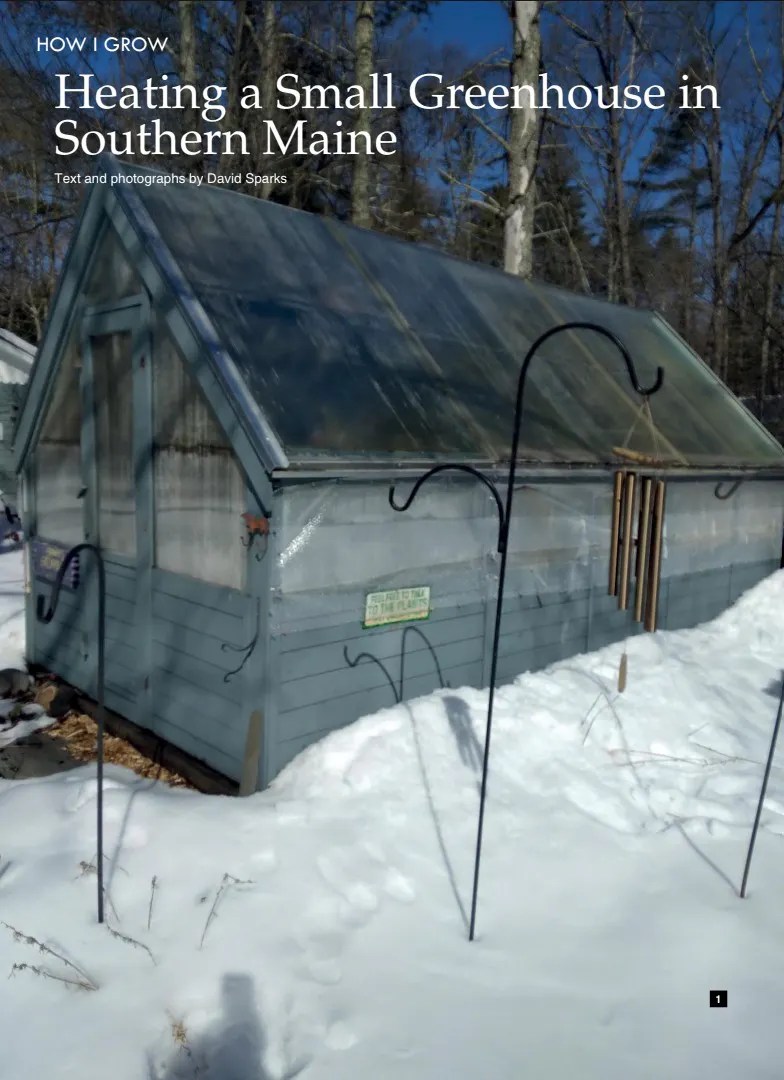
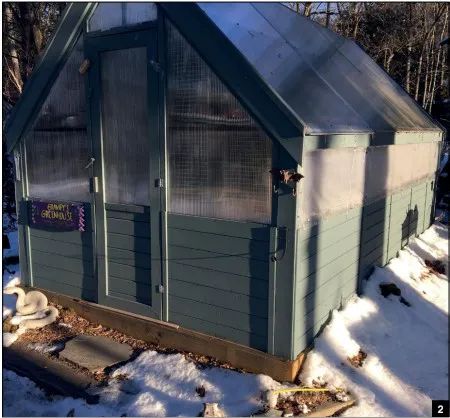
The cedar walls of the greenhouse are 30 inches (76.2 cm) high, to which I have added 4-inch (10.2 cm) thick, rigid Styrofoam insulation, as well as a layer of plexiglass over the side windows with a 2-inch (5.1 cm) air space between the plexiglass and the outside glazing. The greenhouse is situated so the back wall faces the northeast, which I later covered with 2-inch (5.1cm) thick Styrofoam insulation.
[3] Interior view of the greenhouse showing the 5-gallon (19 l) buckets used for water storage to create a heat reservoir.
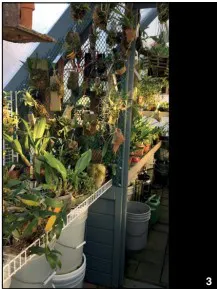
To help stabilize the temperature year-round, I filled 5-gallon (18.9 l) buckets, two high and two deep, with water under the benches. Three small corner fans facing the center and a larger south-facing oscillating fan mounted near the top of the north end run continuously night and day.
During warmer weather, the door is left open with a screen door closed to keep out unwelcome creatures. I do not use shade cloth on the roof, as a few deciduous trees provide shade. I use a hose to water during the summer, and a battery-operated sprayer in the winter.
[4] A small portion of the author’s very happy plants.
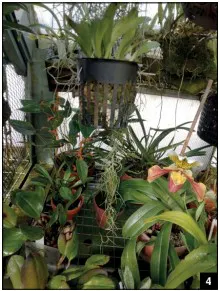
In the winter, temperatures here can reach the -20s F (<-28.9 C). I use two fan-operated, 900-watt electric heaters in the center of the floor, one facing north and one facing south. They are on separate circuits controlled by a digital Inkbird thermostat to keep the temperature no cooler than 50 F (10 C). I also use a Tempstick alarm which will notify me if the greenhouse gets cooler than 49 F (9.4 C) or
over 100 F (37.8 C). In case of power loss, a portable battery-started generator and a small My Buddy portable propane heater fueled with camping-size cylinders can be used as back up heat.
With this setup, my total cost for the coldest winter has been under $600.00. With the cost of electricity here being around $0.29/kWh, the roughly 400 mounted and potted plants have cost about $1.50 each to keep safe and warm for the season.
This system works well for me, but there is a downside. Someone must be close by during the coldest part of winter in case of power loss. Luckily, we are not snowbirds, and we do have close neighbors and family who can be here if needed for short periods.
— David Sparks (email dsparks5151@gmail.com).