

I am no different than any other orchid grower and have certainly killed my share of orchid plants. Attempting to grow orchids and bromeliads in less-than- ideal conditions, with fluorescent tube light bulbs and moving several times in my youth, was not a recipe for success. In my 50 years of orchid growing, I have had to adapt; keeping detailed records of cultural requirements was key to a better outcome.
[1] Trichocentrum splendidum grows well in my greenhouse as long as I keep it dry during the cold winter months.
In 1990, my wife and I finally moved into our “forever home,” and in 2008, added a 16-foot × 9-foot (4.8 × 2.7 m) lean-to greenhouse. This greenhouse and two terrariums house over 200 orchids in 66 natural and hybrid genera! With a good southeast exposure, I can keep my southeastern Pennsylvania greenhouse with twin-wall polycarbonate glazing and baseboard hot-water heat, warm enough in the winter to grow mostly “intermediate temperature” (~ 55–85 F [13–30 C]) orchids. My research indicated that I would have more choices in orchid genera than if I had chosen the warmer or cooler growing genera. However, even the typically warmer-growing Trichocentrum splendidum flowers in my intermediate greenhouse. A Schoenorchis fragrans, however, does better in the year-round warmer temperature of my large terrarium.
[2] Schoenorchis fragrans — One of only 25 species in this genus, grows well in low light and constant temperature in a large terrarium.
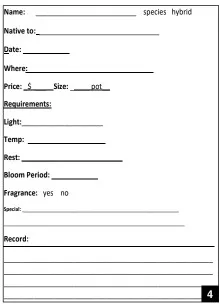
As I began building my collection of varied genera with differing cultural requirements, I realized a system to track my plants and their requirements was necessary. I developed what I call a Culture Sheet for each plant and keep them in a binder. The sheet is very self-explanatory and allows me to keep all researched cultural information in one easy-to-read page. The section labeled Special includes special requirements such as “prefers small pots,” or “much less water in the winter.” Record is where I jot down bloom dates and when the plant was last repotted. And of course, Native To changes to Parentage for he hybrids.
Taking the binder into the greenhouse is cumbersome and risky if the misters come on. An Excel spreadsheet listing all my plants solved that problem. The spreadsheet only contains select cultural data for ease of use; I even color-coded some information as a visual aid. The culture sheets still retain the bulk of researched information. A printed Excel spreadsheet is more convenient to carry into the greenhouse, and the data helps with placement of an orchid into the sunnier, or shadier spots, depending on cultural needs. The spreadsheet also comes in handy when I go shopping and cannot remember if I already have a plant that has caught my attention.
[3] Plant Listing
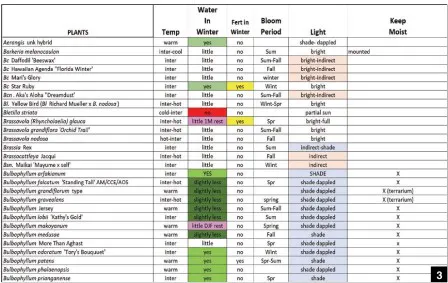
The Plant List spreadsheet has evolved over the years as I inserted or deleted columns. At one point, I added a tab for winter watering frequency. Later, I adopted colored plant tags to indicate each plant’s watering requirements (Velasco 2024). It has proven to be more efficient than referring to a paper copy.
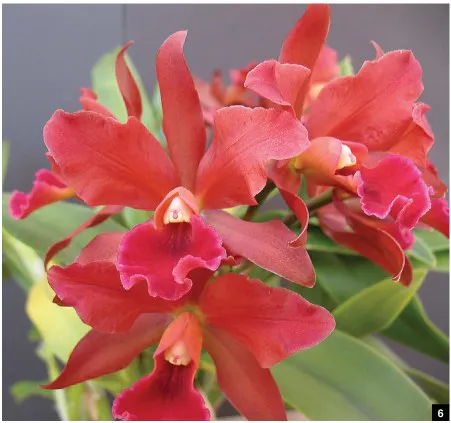
My Cattlianthe India Rose Sherwood does not get a tag, as most of my cattleyas get the same amount of water. Some growers might prefer to group their plants that require the same watering frequencies.
With my collection, temperature and light play the dominant role in where the plant is placed in the greenhouse, and sometimes that does not match the watering requirements for the winter.
[4] Culture Sheet
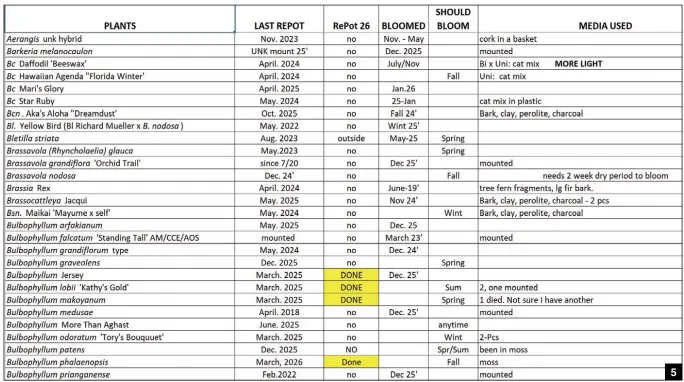
The latest stop on this journey was a separate tab on my spreadsheet, covering repotting. This list allows me to use the winter months to prepare for the upcoming repotting season. I can inspect
a plant, see when it was last repotted, and decide if it is due for repotting. In addition to the “last bloomed column,” I added a column of when the plant “should bloom” if it has not bloomed in some time, or never bloomed for me. This gives me the nudge to investigate why it has not bloomed
lately or why it has never bloomed, and what could be done differently.
[5] Repotting Schedule
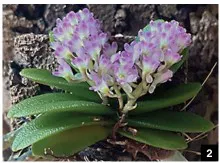
Most of us gravitate to plants we find attractive or because we can grow and flower them well without much effort. Where is the challenge in that? My multi-genera collection has something blooming almost year-round. Keeping clear records can help any grower, novice to experienced, be more successful in nurturing orchids with different requirements.
[6] Cattlianthe India Rose Sherwood purchased from a big-box store as a bare root “plant in a bag” in 2008 has turned into quite the specimen plant.
Reference
Velasco, K. 2024. Organizing Orchid Tags. Orchids 93(9):689.
Many thanks to my lovely wife, Denise, and Daniel L. Geiger, who provided editing support.
—Jan Edward Teitsworth is a retired health and safety specialist who lives with his wife Denise and dog Maisie in a Philadelphia suburb, and is a member of the Southeastern Pennsylvania Orchid Society. He has been growing orchids and bromeliads on and off for 50 years.