

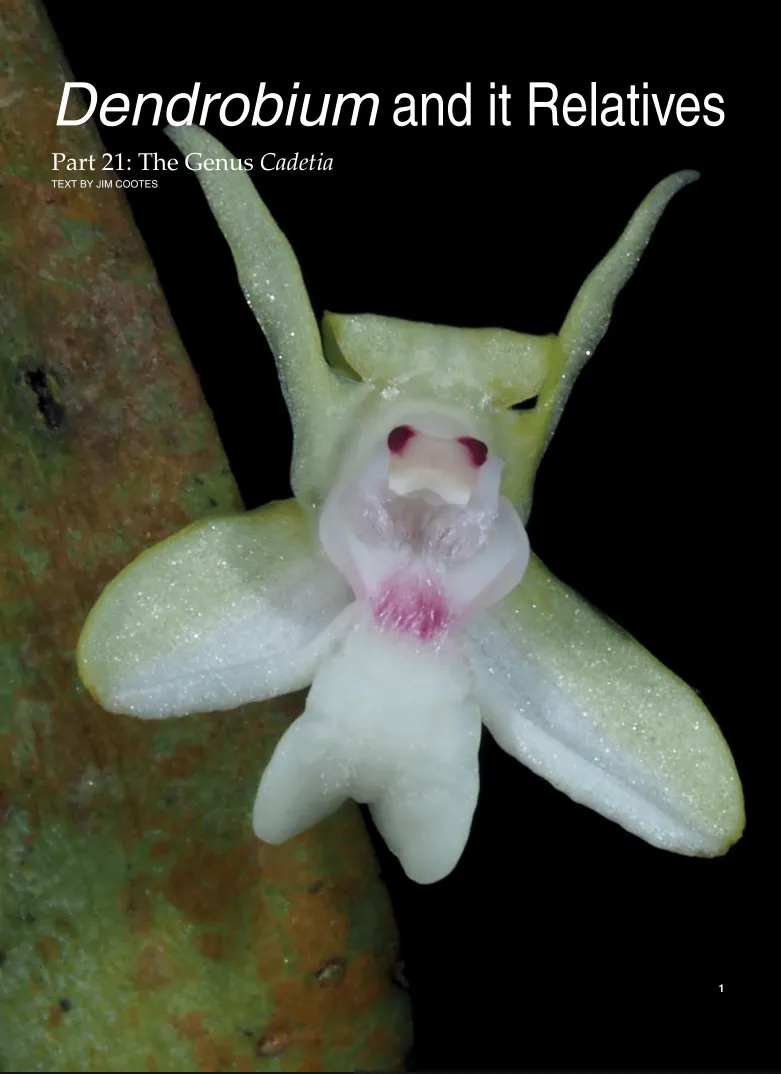
The genus Cadetia was first proposed by Charles Gaudichaud–Beaupré in 1826 in Voyage autour du Monde, enterpris par Ordre du Roi, ... Execute sur les Corvettes de S.M. l’Uranie et la Physicienne... par M. Louis de Freycinet. Botany (Voyage around the World undertaken by Order of the King, ...Executed on the Corvettes of HM Uranie and the Physician...by M. Louis de Freycinet. Botany...) The generic name honors Cadet de Gassicourt, who was the author of a dictionary of chemical terms. The type species for the genus is Cadetia umbellata Gaudichaud. There are about 90 species in the genus, primarily found in the mountains of New Guinea. At present, Plants of the World Online accepts Cadetia as a section of an expanded genus Dendrobium.
Plants are usually small, clumping, with a single upright pseudobulb, which in some species is square in cross–section, bearing a single leathery leaf. The flowers are usually white with yellow, orange or pink markings in the labellum, and appear from the top of the pseudobulb at the junction of the leaf.
Cadetia arfakensis was described by Rudolf Schlechter in 1922 in Botanische Jahrbücher für Systematik, Pflanzengeschichte und Pflanzengeographie. Leipzig (Botanical Yearbooks for Systematics, Plant History, and Plant Geography. Leipzig). The specific epithet refers to the Arfak Mountains in New Guinea. Plant reaches 4 inches (10 cm) in height. Flowers are about 3⁄4 of an inch (2 cm) across. This species is endemic to New Guinea, where it grows at elevations between 2,000 and 6,300 feet (600–1,900m) in limestone hill forest.
[1] Cadetia arfakense. Photograph by Jeff Champion.
Cadetia collina was named by Rudolf Schlechter in 1912 in Repertorium Specierum Novarum Regni Vegetabilis (Repertory of New Species of the Vegetable Kingdom). The specific epithet refers to the hilly habitat where this species grows. Plants reach 5 inches (12.5 cm) in height and carry a single leathery leaf. The flower is about 3⁄8 inch (1 cm) across. This species is endemic to Papua New Guinea, and it grows as an epiphyte at elevations up to 1,600 feet (500 m).
[2] Cadetia collina. Photograph by Jeff Champion.
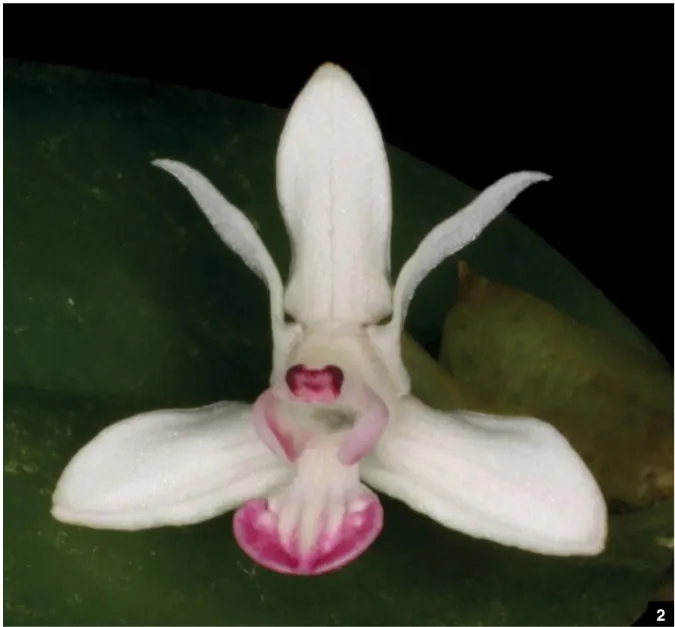
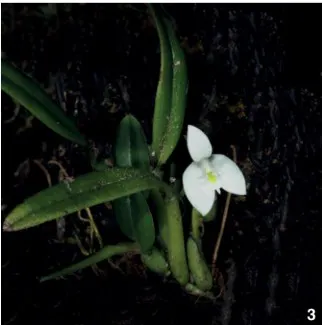
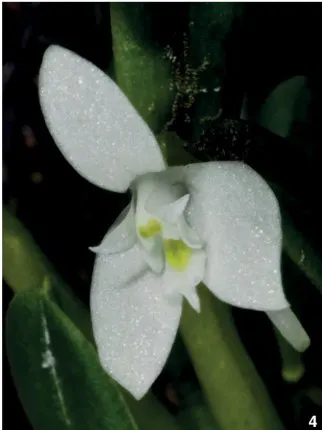
Cadetia fluctuosa was first named as Dendrobium fluctuosum by J.J. Smith. Peter Hunt transferred it to the genus Cadetia in 1971 in the Kew Bulletin. The specific epithet refers to the wavy ridges on the pedicel and ovary. Plants reach about 1 inch (2.5 cm) in height. Flowers are large for the genus at about 1 inch (2.5 cm) across. This orchid is endemic to New Guinea. It grows as an epiphyte at elevations between 4,100 and 6,600 feet (1,250–2,000 m).
[3] Cadetia fluctuosa illustrating plant habit and relative flower size. Photograph by Jeff Champion.
[4] Close–up of Cadetia fluctuosa. Photograph by Jeff Champion.
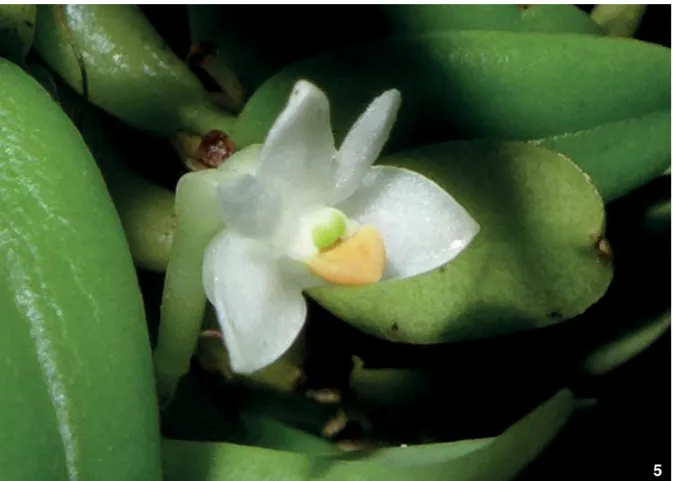
Cadetia funiformis was named by Rudolf Schlechterin 1912 in Repertorium Specierum Novarum Regni Vegetabilis (Repertory of New Species of the Vegetable Kingdom). The specific epithet may refer to the “cable–shaped” rhizome. Plants reach about 1 inch (2.5 cm) in height. Flowers are about 3⁄8 inch (8 mm) across. This orchid is endemic to New Guinea, where it grows both as an epiphyte and lithophyte at elevations up to 2,600 feet (800 m).
[5] Cadetia funiformis. Photograph by Jeff Champion.
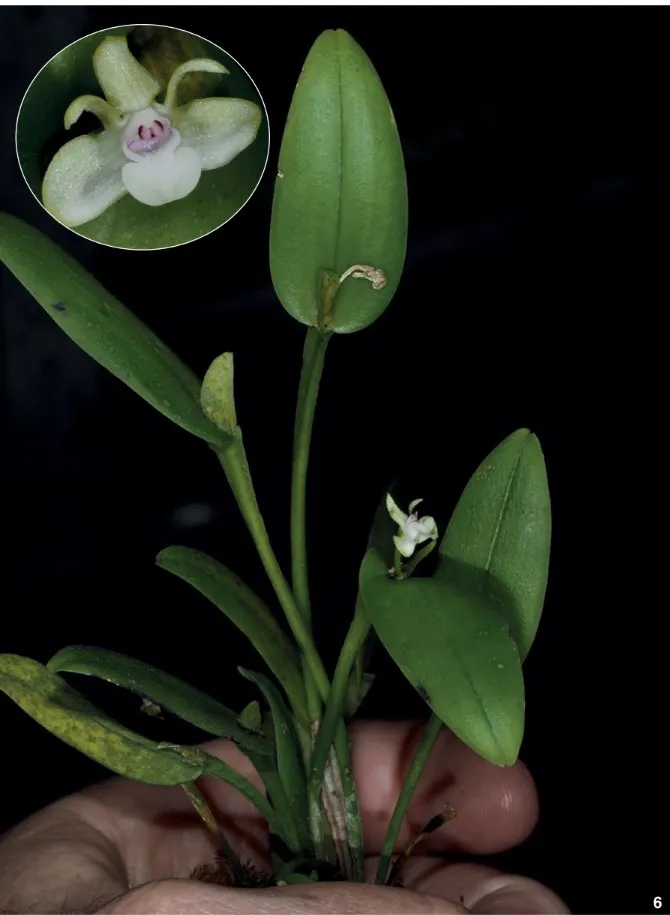
Cadetia lucida was named by Rudolf Schlechter in 1912 in Repertorium Specierum Novarum Regni Vegetabilis (Repertory of New Species of the Vegetable Kingdom). The specific epithet refers to the bright color of the flowers. Plants reach about 21⁄2 inches (6 cm) in height. Flowers are about a 1⁄4 inch (6 mm) across. This orchid is endemic to New Guinea, where it grows as an epiphyte at elevations up to 330 feet (100 m).
[6] Cadetia lucida. Photograph by Jeff Champion.
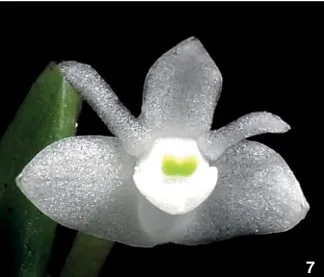
Cadetia microphyton was first named as Dendrobium microphyton by Louis Williams. It was transferred to the genus Cadetia by the late Dr. Eric Christenson in 1992 in Lindleyana. The specific epithet refers to the dwarf growth habit of this species. The plant is about 11⁄2 inches (4 cm) tall. The flowers are about 11⁄4 inch (6 mm) across. This species is endemic to the southern Philippines, where it grows as an epiphyte and occasionally on rocks at elevations between 1,000 and 4,000 feet (300–1,000 m).
[7] Cadetia microphyton. Photograph by Miguel David de Leon.
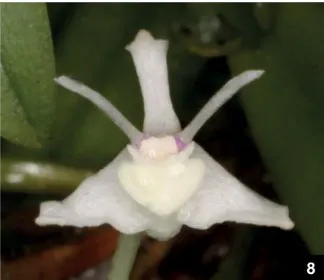
Cadetia potamophila was named by Rudolf Schlechter in 1912 in Repertorium Specierum Novarum Regni Vegetabilis (Repertory of New Species of the Vegetable Kingdom). The specific epithet refers to the river–loving habitat of the plant. Plants reach 11⁄2 inches (4 cm) tall. Flowers are about 1⁄4 inch (6 mm) in diameter. This orchid is endemic to New Guinea, where it grows as an epiphyte at elevations between 500 and 650 feet (150–200 m).
[8] Cadetia pomatophila. Photograph by Jim Cootes.
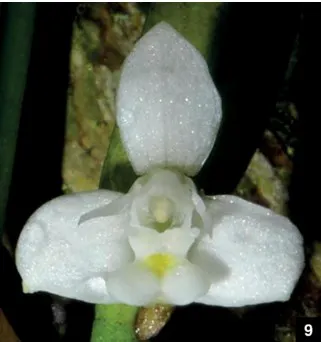
Cadetia quinqueloba was named by Rudolf Schlechter in 1912 in Repertorium Specierum Novarum Regni Vegetabilis (Repertory of New Species of the Vegetable Kingdom). The specific epithet refers to the five lobes of the labellum. Plants reach about 3 inches (7.5 cm) in height. The flowers are about 3⁄8 inch (1 cm) in diameter. This orchid is endemic to New Guinea, where it grows both as an epiphyte and lithophyte at elevations up to 6,000 feet (1,800 m).
[9] Cadetia quinqueloba. Photograph by Jeff Champion.
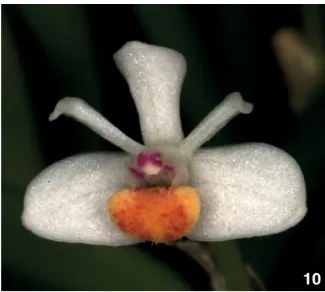
Cadetia taylorii was named by Rudolf Schlechter in 1912 in Repertorium Specierum Novarum Regni Vegetabilis (Repertory of New Species of the Vegetable Kingdom). The specific epithet refers to Mr. N. Taylor, who first collected this species. Plants reach 4 inches (10 cm) in height and carry a single leathery leaf. The flower is about 3⁄8 inch (1 cm) across. This species is found in northern Australia and possibly Papua New Guinea. It grows as an epiphyte at elevations up to 4,000 feet (1,200 m).
[10] Cadetia taylorii ‘Mike’s Best’. Photograph by Jim Cootes.
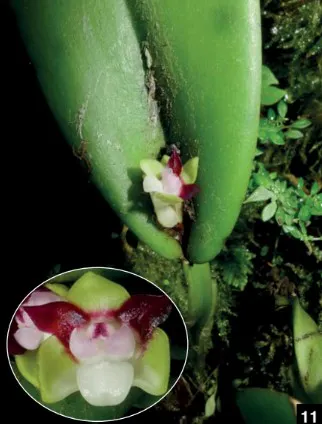
Cadetia transversiloba was named by Rudolf Schlechter in 1912 in Repertorium Specierum Novarum Regni Vegetabilis (Repertory of New Species of the Vegetable Kingdom). The specific epithet refers to the transverse (at right angles to another organ) lip midlobe of this species. Plants reach 5 inches (12.5 cm) in height and carry a single leathery leaf. The flower is about 3⁄8 inch (1 cm) across. This species is endemic to Papua New Guinea, and grows as an epiphyte at elevations up to 1,600 feet (500).
[11] Cadetia transveriloba. Photograph by Jeff Champion.
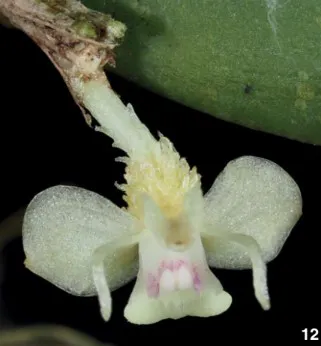
Cadetia umbellata was named by Charles Gaudichaud–Beaupré in 1826 in Voyage autour du Monde, enterpris par Ordre du Roi, ... Execute sur les Corvettes de S.M. l’Uranie et la Physicienne... par M. Louis de Freycinet. Botany (Voyage around the World undertaken by Order of the King, ...Executed on the Corvettes of HM Uranie and the Physician...by M. Louis de Freycinet. Botany...) The specific epithet refers to an umbrella–shaped feature of the plant or flower. The plant gets to 21⁄2 inches (7 cm) tall. The flowers are about 3⁄8 inch (1 cm) across.
This is the most widely distributed species in the genus, and it has been recorded from the Bismarck Archipelago, Java, the Lesser Sunda Islands, the Moluccas, and New Guinea. It grows as an epiphyte from sea level up to 1,300 feet (400 m).
[12] Cadetia umbellata. Photograph by Jeff Champion.
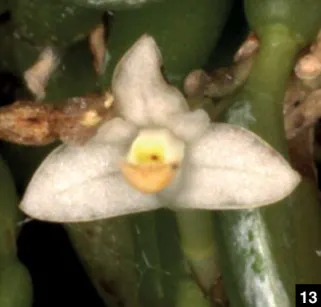
Cadetia wariana was named by Rudolf Schlechter in 1912 in Repertorium Specierum Novarum Regni Vegetabilis (Repertory of New Species of the Vegetable Kingdom). The specific epithet refers to the Waria Mountains of New Guinea. Plans reach 2 inches (5 cm) in height and carry a single leathery leaf. The flower is about 1⁄4 inch (5 mm) across. This species is endemic to Papua New Guinea, the islands of the Torres Strait, and northern Australia. It grows as an epiphyte at elevations of between 650 and 2,600 feet (200–800 m).
[12] Cadetia umbellata. Photograph by Jeff Champion.
Acknowledgments
My sincere thanks to Jeff Champion (Bali, Indonesia) and Miguel David De Leon (Philippines) for the use of their pictures to enhance this article.
Further Reading
Lavarack P.S., W. Harris W. and G. Stocker. 2000. Dendrobium and its Relatives. Kangaroo Press.
O’Byrne P. 1994. Lowland Orchids of Papua New Guinea. SNP Publishers Pte Ltd
Schlechter R. 1982. The Orchids of German New Guinea. Translated by R.S. Rogers, H.J. Katz, and J.T. Simmons, edited by D.F. Blaxell, Australian Orchid Foundation, Melbourne.
de Vogel E.F., J.J. Vermeulen and A. Schuiteman, Orchids of New Guinea. www.orchidsnewguinea.com
— Jim Cootes has grown orchids for almost 50 years. He specializes in species orchids of Australia and Asia, particularly those of the Philippines. Mr. Cootes has written three books on Philippines orchid species and has also written countless articles, both scientific and of a more general nature that have been published worldwide. He lives in Sydney, Australia, where he keeps a small collection of orchids (email jimcootes@gmail.com).