

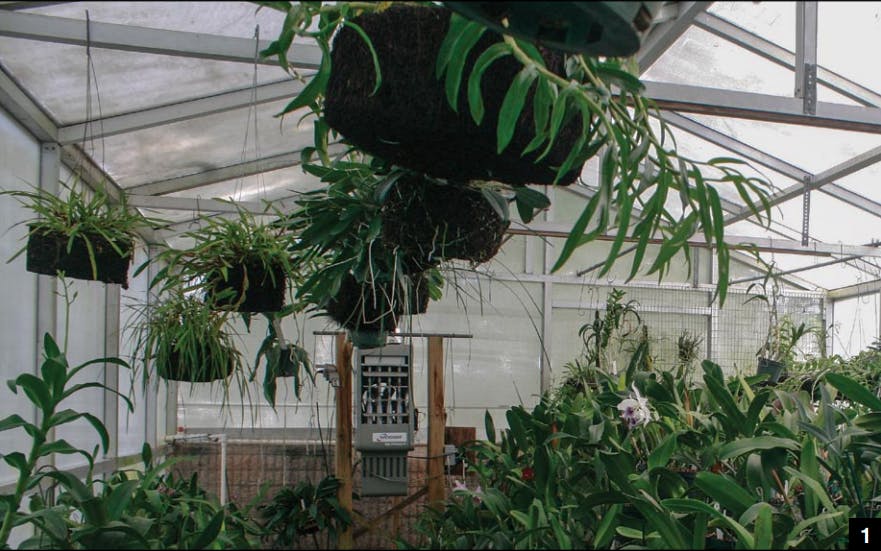
My ORCHID CLUB got a phone call one day. Were we interested in buying an orchid collection? Mary Hollingshead, an orchid grower in Jacksonville, had died unexpectedly. When we went to her greenhouse to look around, we found many healthy plants obviously grown by an experienced orchid grower. We learned a lot just by looking at her plants, realizing she had picked up many tricks on how to best grow her plants with interesting and new (to us) ways of staking and propagating them. She had lots of specimen–sized plants, many growing in tree fern baskets.
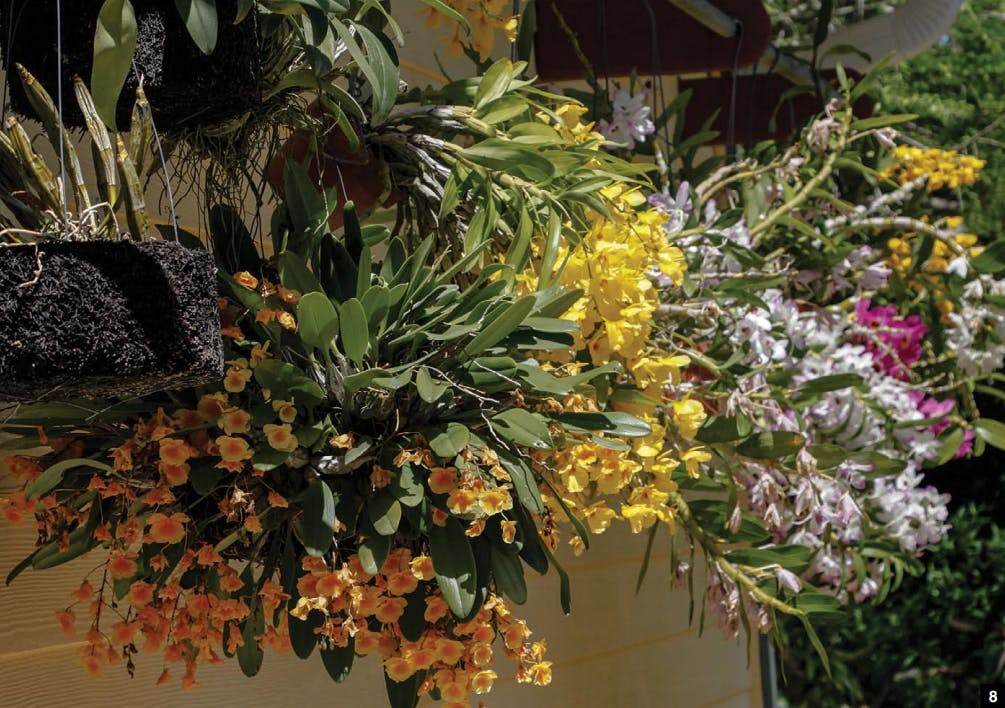
[1] Mary Hollingshead grew many different types of orchids in her smallish greenhouse, including many dendrobiums in tree fern baskets.
TREE FERN POTS Round tree fern pots are carved from the trunk of the giant tree fern found in South America. These pots have excellent drainage and aeration and function both as the growing medium and the container. The pots are typically from 4 to 8 inches (10 to 20 cm) in diameter and 4 to 6 inches (10 to 15 cm) deep, although larger pots are available. The hollowed–out center of the pot tends to be smallish, maybe less than half the depth and width of the pot. The quality of the tree fern varies from fibrous to dense, so care should be exercised in pot selection. The denser pots will last for many years, but the very fibrous pots probably should be broken into pieces and used as potting medium inside another pot. The smaller–sized pots can normally be found for a few dollars, so they are roughly equivalent in cost to clay orchid pots.
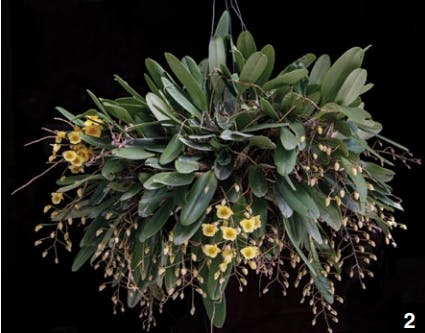
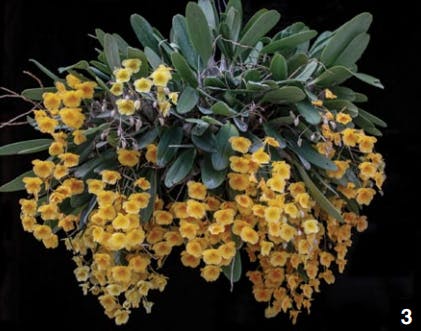
[2–3] This Dendrobium lindleyi, potted in a tree fern basket, was one of Mary’s. It came home with me and has been putting on an annual show every year since 2011. The basket is still in fine shape four years later.
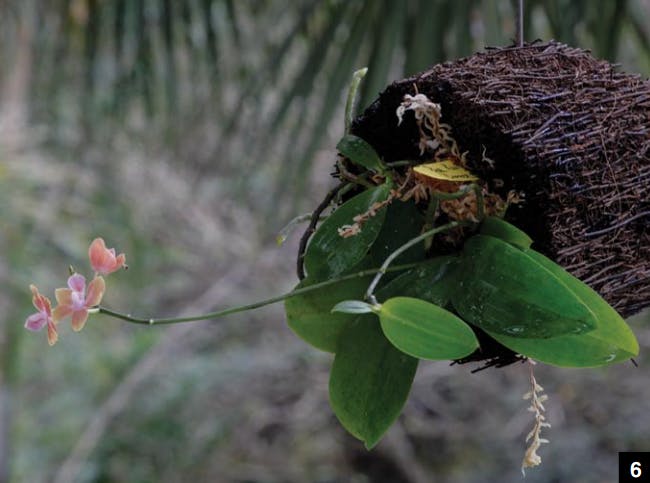
POT, MOUNYT OR BASKET? So many choices! Some people use tree fern baskets as a pot sitting on a horizontal surface so the pot can be brought inside and used as a centerpiece. Some people use them as a vertical mount, inserting a wire S–hook through the tree fern and tying the plant in place until it becomes established. This is a great way to grow phalaenopsis outdoors because the crown of the plant can be pointed downward, allowing rainwater to drain easily. They make great horizontal baskets that can be suspended with wire hangers. The plants seem to acclimate very quickly to their new homes, and the plant presentation is very attractive.
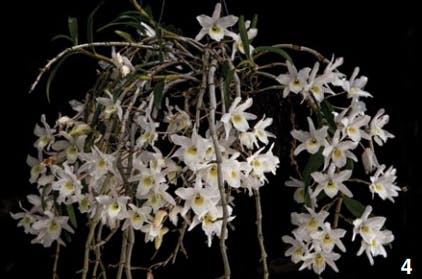
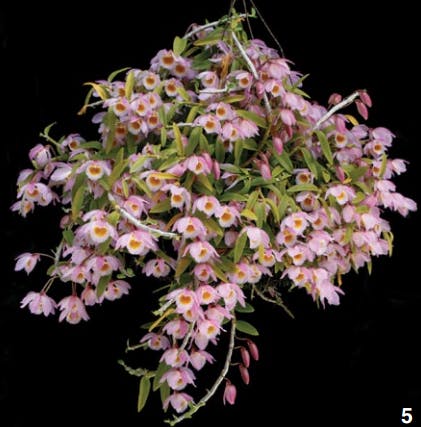
[4–5] The Dendrobium and Densiflora (Callista) Section dendrobiums are well suited to tree fern culture, because they love to be grown in seemingly too small pots with almost monsoonal conditions during the growing season, followed bya coolish, dry winter rest before they burst into glorious bloom in the spring. It takes only a few years to grow specimen plants, such as this Dendrobium anosmum [4] or Dendrobium loddigesii [5].
SELECT THE RIGHT PLANT Choose a plant with tightly clustered pseudobulbs or canes for your basket. You want your plant to be happy in its new home for about the next five years, so you will have to plan for the now and then.
[6] Seedling multifloral Phalaenopsis such as this Phalaenopsis Kuntrarti Rarashati have small root balls, so they are easy to establish in a tree fern basket.
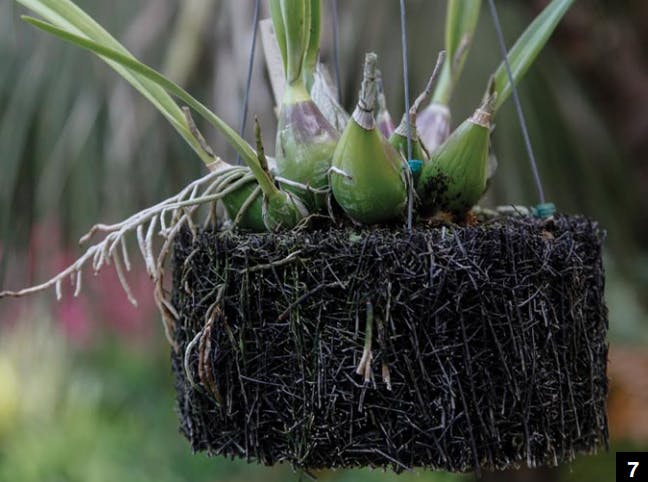
[7] In the Cattleya Alliance, brassavolas and encyclias are the most suitable for tree fern baskets because the plants have tightly spaced pseudobulbs.
— For now, you will want a plant that is small enough to fit into the small opening in the pot, so think young. Dendrobium keikis from one of your friends are perfect. Seedlings in 2–inch (5–cm) pots work well.
[8] Here a selection of dendrobiums grown for many years in tree fern baskets put on a spectacular spring display.
— For the future, you will have to envision what the plant will look like in a couple of years. You will want to avoid very tall plants or leggy plants with big spaces between pseudobulbs. Small cattleyas with densely spaced pseudobulbs, such as many encyclias and brassavolas, work well. Many of the dendrobiums are good candidates, including the pendulous seminobile dendrobiums, such as Dendrobium anosmum or the Densiflora Section (also called the Callista Section) dendrobiums, such as Dendrobium lindleyi and Dendrobium jenkinsii.
POTTING YOUR PLANT If you are potting up a seedling in a small tree fern basket, set your seedling in the middle of the pot and pack AAA long–fibered New Zealand sphagnum moss around it. Only use the highest–quality sphagnum moss so the moss will last at least two years, and by then the roots will have grown in and through the tree fern basket. You can interlayer timed–release fertilizer with the moss, particularly if you do not fertilize your plants routinely. If you do not like sphagnum or if you are using larger tree fern baskets, you can use your potting mix of choice, although you may not be able to hang your pot vertically.
[9] Use a thick gauge wire to prepunch holes for the wire hanger if you are using four–strand wire hangers.
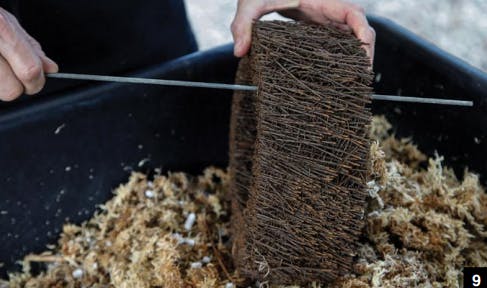
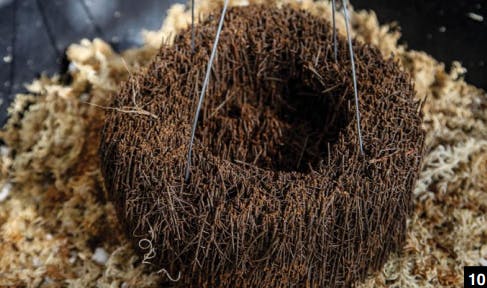
[10] Insert the wire hanger through the prepunched holes or push the thicker double–wire hanger through the basket.
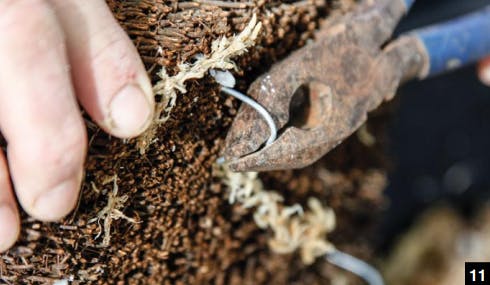
[11] Bend the hanger into a U–shape and push it back into the base of the basket to secure it in place.
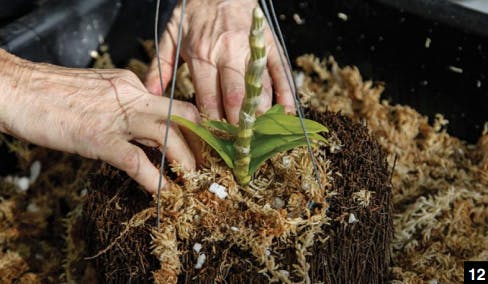
[12] Center the seedling in the pot and pack with AAA long–fibered New Zealand sphagnum moss.
HANGING YOUR PLANT If you are going to hang the pot horizontally as a basket, you can use a standard four–strand 16–gauge wire hanger. You can use a thick–gauge straight wire to punch holes in the basket as a guide so the thin wire of the hanger can be easily inserted, and then simply bend the wire horizontally or into a U–shape at the base of the basket. Better yet, find the two–pronged 12–gauge wire hanger (hat tip to Michael Polen of Art Stone Orchids) available from orchid supply houses, such as Tropical Plant Products. This thicker–gauge wire is much easier to push through the basket than the thinner four–strand wire hanger.
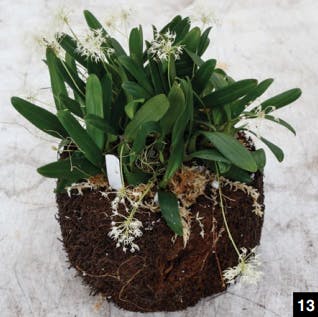
[13] Bulbophyllums, such as this Bulbophyllum laxiflorum may also be good choices for tree fern baskets. Some can be leggy, so keep a supply of floral pins handy so you can tack the bulbs back into the basket.
If you want to try growing in tree fern baskets, start with seedlings or plants that have a small root mass. Choose plants that like to be potted in smallish or shallow pots as well as lots of moisture during the growing season, particularly if you are surrounding the roots with sphagnum moss. If they like drier conditions during the winter, either move them to a drier spot or simply restrict water during their resting season. Choose plants that have densely clustered pseudobulbs or canes so they will be able to grow for many years in the basket without disturbing the roots. Then kick back and wait for the blooms. You will love the presentation in the tree fern basket and the increasing number of flowers you will get with every passing year.
— Sue Bottom started growing orchids in Houston in the mid–1990s after her husband Terry built her first greenhouse. They settled into St. Augustine, Florida, Sue with her orchids and Terry with his camera, and are active in the St. Augustine Orchid Society, maintaining the society’s website and publishing its monthly newsletter. Sue is also a member of the AOS Editorial Board (sbottom15@hotmail.com)