

ORCHIDS BY DAY. During the day, your plants are busy:
• Making Food. Your plants are busy using solar energy in a process called photosynthesis. Light is absorbed by the chlorophyll in the chloroplasts and the carbon dioxide absorbed by the plant is converted into chemical energy in the form of sugars and starches.
• Using Food. Your plants consume their energy reserves in a process known as respiration. The food reserves of sugars and starches are used to maintain existing tissue as well as produce new growths, flowers and seeds.
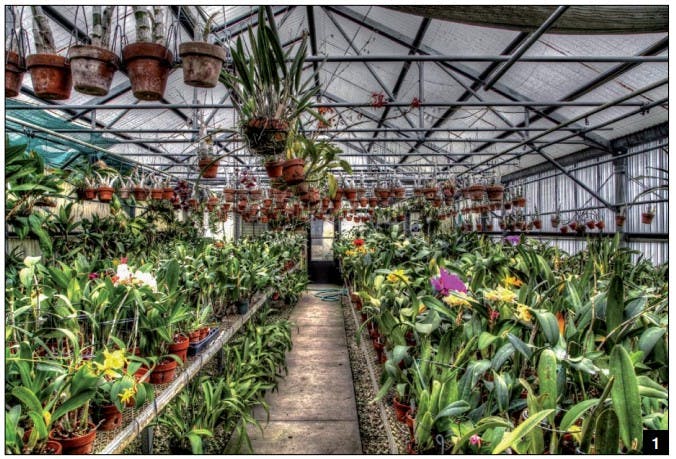
[1] During the day, your orchids are busy converting light energy into chemical energy via photosynthesis, using the available light, carbon dioxide, water and nutrients.
ORCHIDS BY NIGHT. At night, photosynthesis stops but growth and respiration continue drawing on the energy reserves created during the day. Respiration occurs more quickly at higher temperatures than at lower temperatures. At lower temperatures, it is possible for the energy consumption to be less than energy production, allowing the plant to store energy for future use, including flowering. If night temperatures are too high, food is used faster than it can be made so growth is poor and orchids either do not flower or they flower poorly.
[2] At night, your orchids consume energy reserves in a process called respiration. Respiration is temperature dependent so less energy is consumed when nights are cooler, leaving the plant more energy to produce flowers.
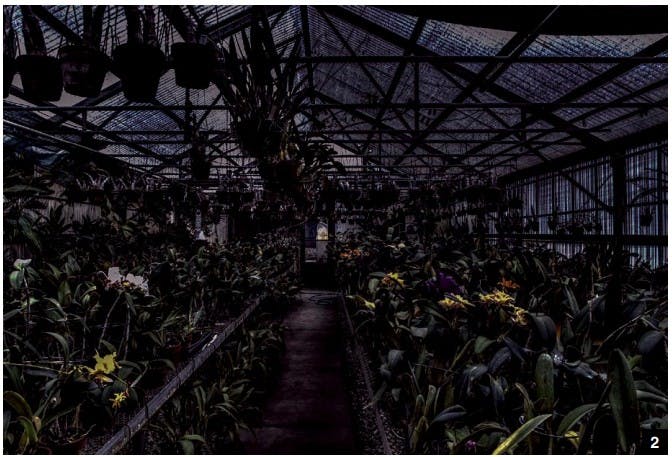
PROVIDING LOWER NIGHTTIME TEMPERATURES. Providing cooler nighttime temperatures can be problematic if you’re growing indoors in a climate controlled environment. Perhaps the best alternative is a programmable thermostat or manually turning the thermostat down at night. Orchids growing by a bright window will be a few degrees warmer during the day from solar gain and orchids growing by an open window may be a few degrees cooler at night in winter. Where possible, you can provide lower nighttime temperatures if you grow your orchids outdoors or on a screened porch during the warm season.
FLOWER INDUCTION BY NIGHTTIME CHILLING. Many orchids require a significant day–night temperature difference to induce flowering. Winter blooming Phalaenopsis require a 15 F (8.3 C) drop in nighttime temperature for two or three weeks to initiate their flower spikes. Cymbidiums and dendrobiums can require an even larger temperature difference. Dendrobium crumenatum is an interesting species that opens all its blooms simultaneously eight or nine days after a thunderstorm; some believe this is a result of the cooling effect of the evaporation of rainwater.
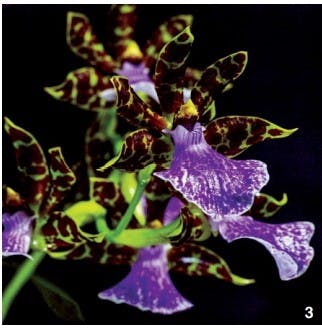
ZYGOPETALUMS CRAVE COOLER NIGHTS. I have long loved zygopetalums with their bluish purple, green and bronze flowers and incredible fragrance, although they have tended to be very short-lived in my care. I’ve tried growing them in a wide variety of light conditions and potting mixes. Knowing that they like cooler conditions than we have in St. Augustine, I tried the old grower’s trick of growing them in sphagnum moss in a clay pot dropped in a second clay pot to keep them a little cooler from the water evaporating from the porous clay. They grew better, but still struggled. I was telling Fred Clarke of Sunset Valley Orchids my tale of woe and he told me to get them out of the greenhouse and under the shade of a tree. That provided a few extra degrees of nighttime cooling and the growth rate exploded over the summer. I was treated to more zygo blooms than ever before.
[3] Zygopabstia Cosmo-Phillips (Judith Phillips × Zygopetalum Artur Elle)
Understanding your plant’s metabolism gives you insight into how best to grow it. Cooler nighttime temperatures allow your orchid to store, rather than consume, the food it manufactured during the day. This stored energy can then be used by the plant to produce flowers. Next to insufficient light, insufficient day to night temperature change is the most likely cause of your orchid failing to bloom. if your plants are growing well and you are sure they are getting enough of the right kind of light, try dropping your night temperatures by a few degrees. You may be pleasantly surprised by the increase in flowers your plants produce.
— Sue Bottom started growing orchids in Houston in the mid-1990s after her husband Terry built her first greenhouse. They settled into St. Augustine, Florida, Sue with her orchids and Terry with his camera. They are active in the St. Augustine Orchid Society, maintaining the society’s website and publishing its monthly newsletter. Sue is also a member of the AOS Publication Committee (sbottom15@bellsouth.net).