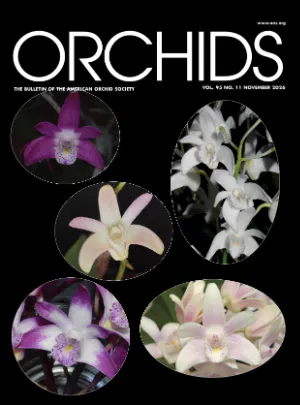


DENDROBIUM DELICATUM IS the cross between two outstanding and variable cool-growing Australian species, Dendrobium kingianum and Dendrobium speciosum. It can produce high-quality hybrids. Despite a wave of popularity in the last quarter of the 20th century, the hybrid is now less common in collections. It has been overtaken by later-generation hybrids, many of which are slower to flower and can be of lesser quality.
Dendrobium ×delicatum is the commonest Section Dendrocoryne natural hybrid and is found in northern New South Wales and southern Queensland, and is present as isolated plants growing closely with the parents. It was described by Bailey, the Government Botanist (1902). Most taxa of Den. speciosum and natural hybrids were unknown, and he initially considered it to be a variety of Den. speciosum.
For more than a century, it was thought that a hybrid made in England and grown and registered with the Royal Horticultural Society as Dendrobium Speckioniganum in 1892 by Sir Trevor Lawrence was a cross between Den. kingianum and Den. speciosum. It was the first Australian artificially produced hybrid. In the 20th century, several Australian botanists doubted that the parents were as stated, particularly because the racemes of the likely Den. kingianum parent had over 20 flowers, higher than the flower count for the species.
Adams (2025) concluded that the Lawrence plant was a cross of Den. ×delicatum and Den. kingianum. Shortly afterward, Den. Delicatum was registered as the grex name for Den. (kingianum × speciosum) and is now the accepted name for the artificially produced hybrid. In Australia, the name Den. Delicatum has always been used by breeders and growers for Den. (kingianum × speciosum).
Dendrobium ×delicatum
Most of these natural hybrids are found in the distribution of Dendrobium speciosum var. hillii, a variety with tall narrow canes, and flowers that are usually white to pale cream and smaller than the other varieties. Plants are large-growing and floriferous but usually lack the floral quality desired for exhibition. At the southern end of the distribution range of Den. kingianum at Mt. Alum near Bulahdelah, northern New South Wales, the Den. speciosum parent is the larger, higher-quality flowered var. speciosum. These plants, colloquially known as Dendrobium ×kestevenii, were described by Rupp (1943) and have impressive features of more compact growth and rounded flowers with fuller segments compared to hybrid plants with var. hillii parentage. For convenience, and because it is still the preferred name, Den. ×kestevenii, a synonym for Den. ×delicatum, is used here for natural hybrids from Mt. Alum.
Natural hybrids are also found with Den. speciosum var. carnarvonense, inland at Carnarvon Gorge, central west Queensland, and with var. grandiflorum from coastal southern Queensland, north of Gympie. The territories are restricted, and few plants have been recorded.
Rescue of Dendrobium ×delicatum and Dendrobium Delicatum
— Many historical and potentially significant plants for breeding were becoming lost. In 2022, a program was commenced to locate remaining plants in collections, gather relevant information about their origins and sources, and set up a collection. The objectives were to promote retention of important plants, investigate the breeding system and explore the best ways to generate quality plants. Another goal was to create improved hybrids and distribute them to growers for exhibition. Information was also collected, especially from older growers, about the origins of plants and the activities of early breeders.
Description of Dendrobium Delicatum
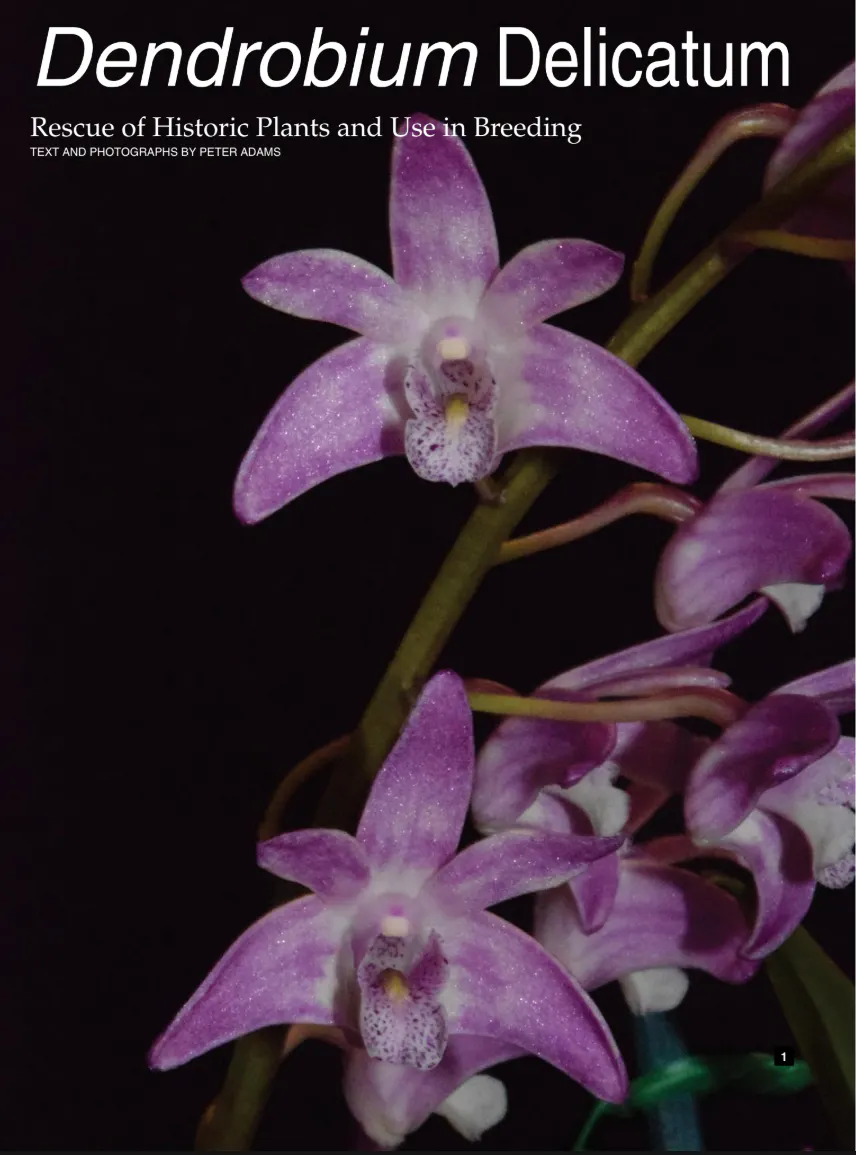
Plants are compact, small to moderate in size, with robust canes 4¾–15 inches (12–38 cm) long, initially covered in an attractive light white vellum. The vegetative features are midway between the parents. The leaves are a deep green, 4–5 per cane at the apex, forming a continuous canopy. Many plants develop a few aerial growths that are useful for propagation, but do not detract from the floral display. The erect or gently arched racemes, 5.12–12 inches (13–30 cm) long, develop over late winter and open in spring. They display around 15–27 flowers, with colors from white to purple and sometimes creamy-yellow, in the rounded style of Den. kingianum, but usually larger. Flower size is 1.14–1.85 inches (2.9–4.7 cm) high and 1.10–1.61 inches (2.8–4.1 cm) wide. There are one to three racemes per cane, usually one or two, creating a spectacular mass of flowers all over the plant. In cool weather, the display lasts for two or more weeks across most of the spring show timetable. There is strong plant growth over summer and autumn, followed by hardening and maturation of canes during the semi-dormant winter period. Seed capsules develop to maturity about 11 weeks after pollination; a little longer than Den. kingianum.
[1] Den. Delicatum ‘Patricia’
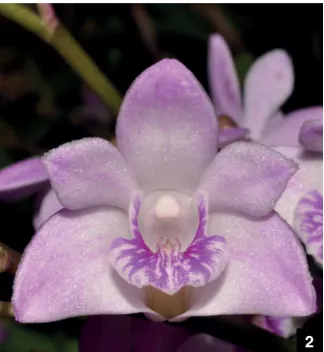
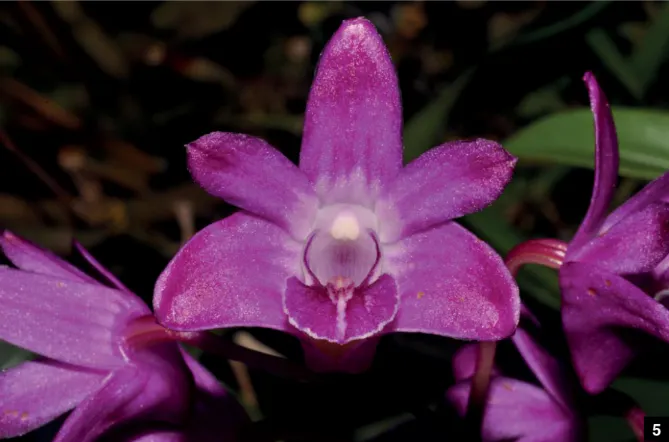
[2] Den. kingianum ‘Pale Dragon’
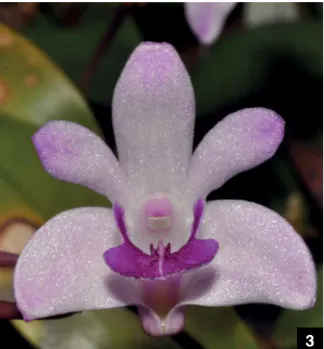
[3] Den. kingianum ‘Purple Peon’
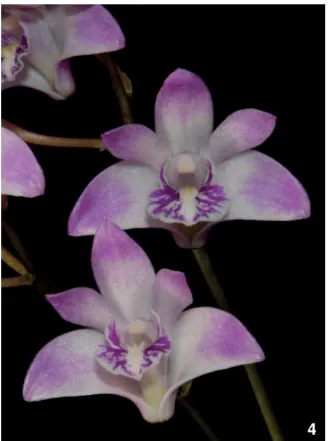
[4] Den. kingianum ‘Big Albert West’
The first artificially raised plants of Den. Delicatum were made by Ira Butler in Sydney in the late 1950s and early 1960s. The details of the crossings are very incomplete. This was the second Dendrobium hybrid raised in Australia, the first being Dendrobium Ellen (kingianum × tetragonum), registered by Schmidt in 1928. The parents used by Butler were not recorded but were probably a mid-north coast Den. kingianum, where the best forms were well known, and Den. speciosum var. speciosum from around Sydney, supplied by Mr. Logan, an associate of Butler who often provided breeding plants. Butler’s Cross No. 181 produced some outstanding white and mauve-colored-flowering plants that are still in collections.
[5] Den. kingianum ‘Blacky No. 1’
Examples of this cross, ‘Daybreak,’ ‘Kerry,’ ‘Ira’ and ‘Cathie White,’ were grown to large specimen size and exhibited at September Spring Shows at Taree, Hastings River Orchid Society at Wauchope and at Port Macquarie on the New South Wales mid-north coast in the 1980s and 90s. They were often very large specimens, over 3 feet (1 m) across, with more than 1,000 flowers, some of award potential. The provincial centers were too distant for judging panels, and hardly any were considered for quality or cultural awards.
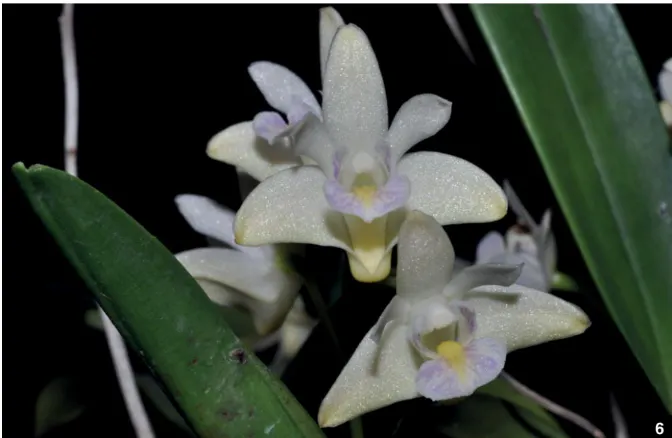
[6] Den. kingianum ‘Dave’s Yellow’
Over the next 20 years, most of these primary hybrids were set aside or thrown away in favor of later generation hybrids, and they are now very difficult to locate in collections. It seems that few attempts were made to use the outstanding plants in further Den. Delicatum breeding, although some attempts were made to remake Den. Delicatum using other varieties of Den. speciosum and purple-flowered Den. kingianum parents.
[7] Den. kingianum ‘Busby’s Flat’
The Place of Dendrobium Delicatum in Collections
Dendrobium Delicatum is one of the easiest plants to grow in cool temperate regions. It flowers profusely and reliably in the spring, in time for the shows. It has a wide range of flower colors and color combinations, and plants exhibit a range of plant heights and forms, including small compact ones with large flowers. Plants can range from small in a 6-inch (15 cm) pot to specimen size in a 13.75-inch (35 cm) container. The flowering duration is good for an Australian hybrid, and the best forms are still competitive. The quality is likely to improve further with renewed activity in breeding using superior parents. Dendrobium Delicatum can augment specialized collections of Den. kingianum, Den. speciosum and more advanced hybrids.
[8] Den. kingianum ‘Tarlington Range’
CULTURE
The conditions required are the same as for most cool-growing Dendrobium section Dendrocoryne. It grows well over a latitude range 27.47°S (Brisbane) to 42.88°S (Hobart) in unheated houses with 50% shadecloth or outside under structures or suitable trees protecting them from excessive sunlight and wild weather. They will tolerate 32 F (0 C) to 113 F (mid-40 C) temperatures, but misting is required at high temperatures to prevent heat damage. The best range for summer growth is 68–86 F (20–30 C). Enclosed houses with good ventilation and air movement are best because the new growths and developing flowers require a covered roof to prevent rain and other damage.
[9] Den. kingianum ‘The Monster’
Pot culture provides the best availability of water to the roots and pots should be spaced to allow light and air movement on all sides. Well-drained potting media are needed, commonly weathered pine bark (or fir in the Northern Hemisphere) and stone or scoria mix. Watering is 2–3 times per week in the summer, tapering off to once every 2–4 weeks in the winter depending on temperature and evaporation. The stems store water, and more damage is done by overwatering than allowing plants to dry out. In the early to late summer growth phase, soft new growths develop quickly. When approaching full height, they should be checked and any wayward ones temporarily staked to ensure they produce an urn-shaped plant that displays the racemes to maximum advantage.
[10] Den. kingianum (Red Devil × Red Ink)
Regular applications of foliar sprays of weak fertilizer during the growing period can be weekly to monthly. Inclusion of a nitrogenous pellet fertilizer at repotting in the spring during the growth period assists growth. In hot weather, slow-release fertilizer can release too much nutrient and damage roots, so it should be used very carefully in small amounts. Pests and diseases are usually not problematic. The commonest are scale, aphids on flowers and sometimes new growths, and slugs and snails. Rats and mice can be destructive pests. Repotting is required in the spring-early summer every 2–3 years or when new growths reach the edge of the pot. Division into plants with no less than 5–6 canes is recommended. Aerial growths, if hardened and with a few developing roots, can be detached and potted in small pots.
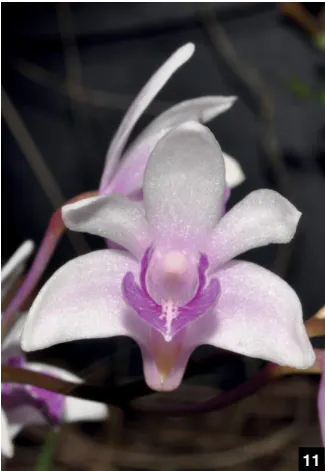
[11] Den. kingianum ‘Pinnacle’
A most important phase is the development of racemes and flower opening, when attention should be given to adequate spacing of plants and identifying crowded racemes. Watch for pests and water thoroughly, then allow the medium to dry out. Flowers open to their best above 68 F (20 C). In cold weather, they may not open fully and evenly. Plants can be temporarily housed in an area with more even temperature, even taking them into the living area for a week before a show. When exhibiting, ensure good positioning in the display, allowing judges to examine all aspects of quality plants.
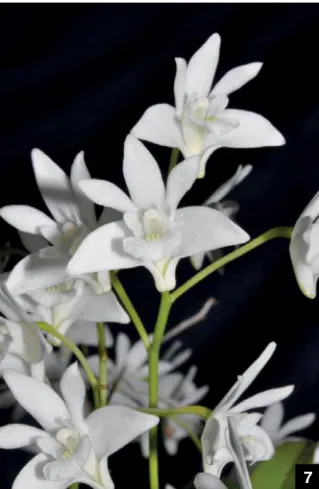
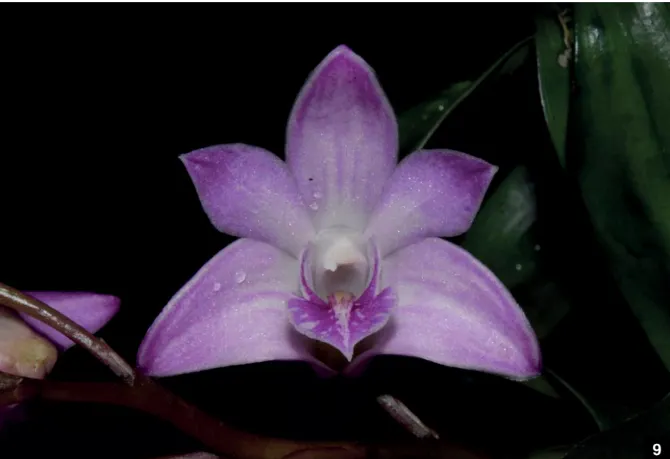
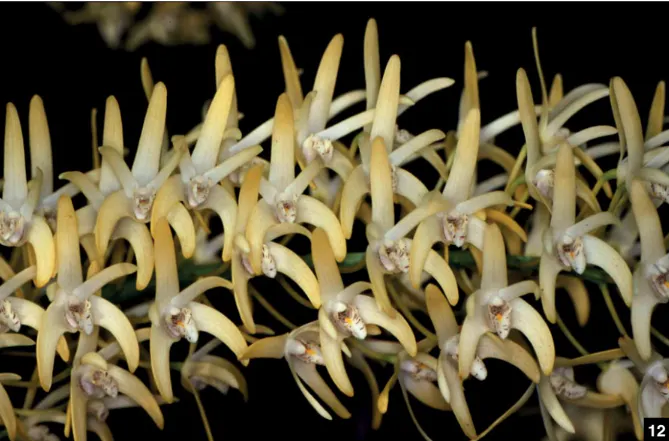
[12] Den. speciosum ‘Windermere’
The Breeding Systems of Den. ×delicatum and Den. Delicatum and Breeding Strategies Natural and artificially produced hybrids are outbreeders and are rarely self-compatible (Adams,1988). Unlike the parents and most Dendrobium section Dendrocoryne hybrids, fertility, defined as the capacity to produce seedlings, is low. It is limited to about 15% in Den. Delicatum, and 2–3 times that for Den. ×delicatum. Many Den. Delicatum plants are also unable to cross with others, and when seed capsules are produced, the number of intact embryos varies from none to many. It is worth sowing even small amounts of seed, as a few seedlings from a promising cross may provide a good starting point for breeding. Rather than crossing two plants that happen to be in flower at the same time, a more systematic practice of identifying plants that are fertile and pass on desirable characteristics is a necessary first step. Early Australian breeders of hybrids discovered that the outstanding Den. Delicatum made by Ira Butler were usually unsuccessful parents, and they had to resort to wild Den. ×delicatum, such as ‘Apple Blossom’ to produce hybrids. This may in part explain the trend away from growing Den. Delicatum after the first wave of enthusiasm.
[13] Den. speciosum ‘Blackdown Gold’
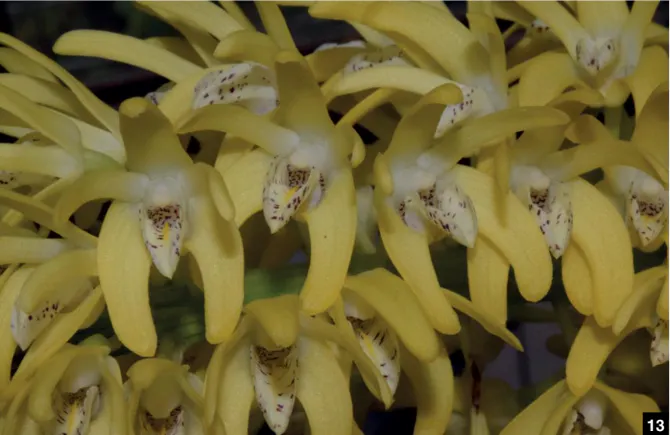
Up to 2025, there were 29 hybrids registered with Den. ×delicatum as a parent, and only 18 with Den. Delicatum. Only a few of the artificial hybrids made with Den. ×delicatum plants were registered with any information on their natural origin. It is puzzling why such a potentially outstanding and vigorous primary hybrid has not had more line-breeding attempts, but low fertility may be part of the explanation.
[14] Den. speciosum ‘Lemon Ice’
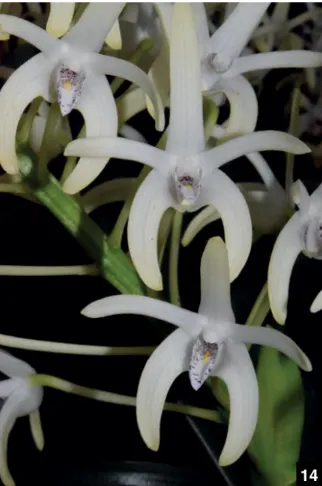
About 40 plants of quality Den. Delicatum were located, and high-quality Den. kingianum and Den. speciosum were collected. In 2025–2026, more than 300 crosses were made of Den. (Delicatum × Delicatum), Den. (Delicatum × ×delicatum), Den. (Delicatum × ×kestevenii) and Den. (kingianum × speciosum). Dendrobium speciosum ‘Windermere’ or ‘Windermere’ seedlings were mainly used as they have been proven to be good parents. The general approach to breeding was to identify fertile plants and eventually to breed flowers of different colors to award-quality standard.
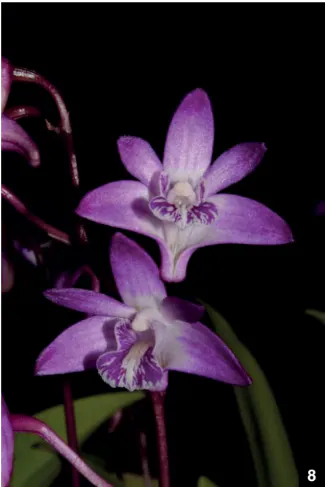
[15] Den. speciosum ‘National White’
[16] Den. speciosum var. speciosum ‘Mt. Alum’
[17] Den. ×delicatum ‘Kerry’
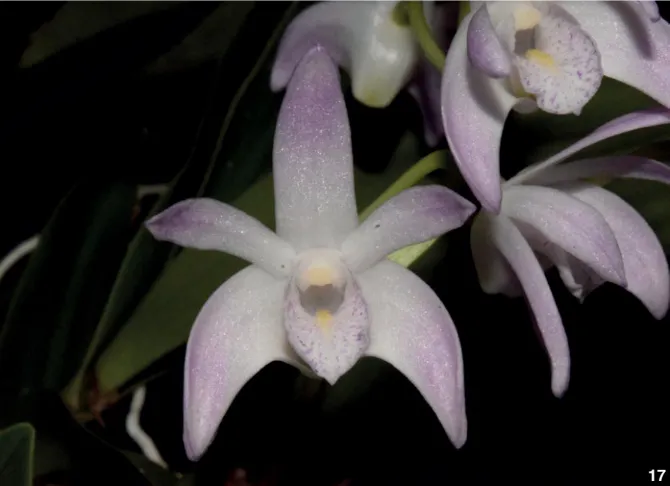
[18] Den. Delicatum (kingianum ‘Tunstead’s Pink Seedling × speciosum ‘Morrie’)
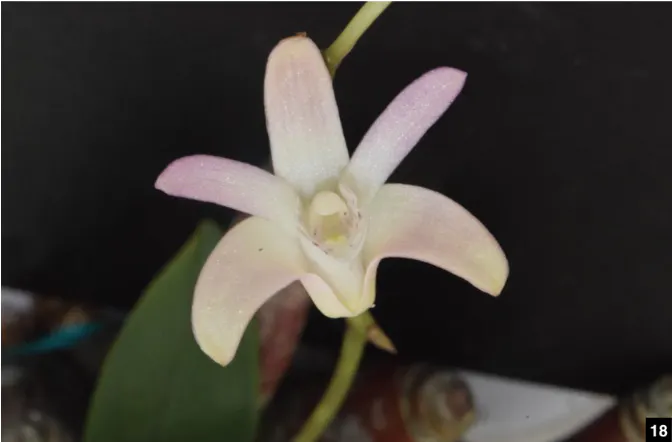
[19] Den. Delicatum (kingianum ‘Jack Penny’ × speciosum ‘Morrie’)
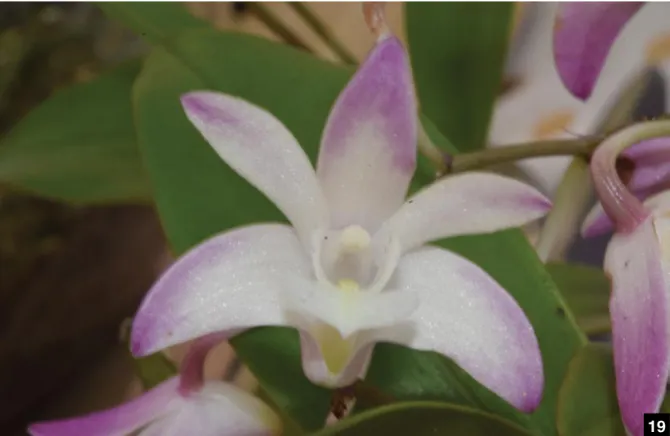
[20] Den. Delicatum ‘Purple Delight’
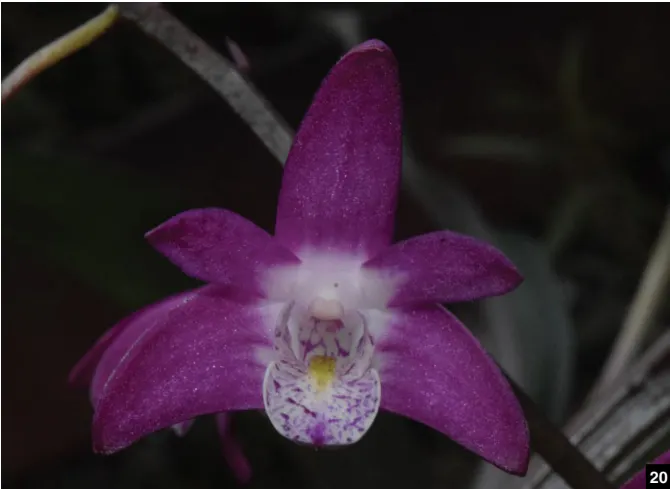
[21] Den. ×kestevenii ‘Coloratum’
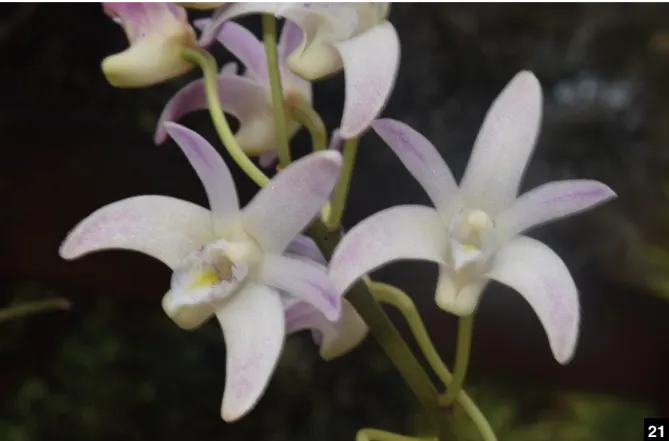
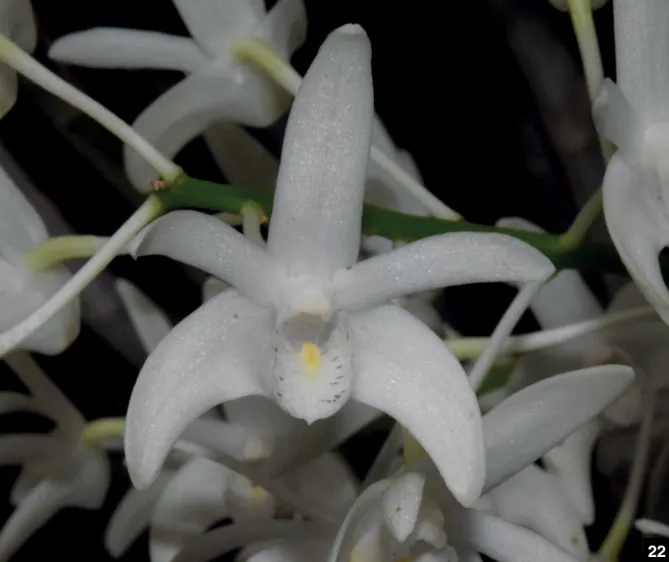
[22] Den. ×delicatum ‘Tracey’
Breeders of Dendrobium Delicatum
Records of breeding and breeders are sparse, and the breeding books generally unavailable. Very little was published in The Orchadian, the Journal of the Australasian Native Orchid Society (ANOS), which was established in 1963 with one of the goals to record breeding activity. There has been no large-scale commercial breeding of Den. Delicatum. The following list records some of the breeders who have produced crosses in their annual catalogs. Some small-scale breeders are listed because they produced quality plants recently rescued and used in successful crossings to make more Den. Delicatum. The list is not exhaustive.
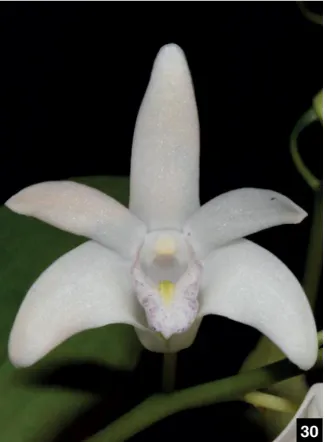
Ira Butler
Before in vitro sterile culture was developed, seed was raised by scattering it on damp mats or around the base of orchid plants, on top of the growing medium. The number of seedlings produced was low, but Butler is known to have supplied some commercial orchid nurseries around Sydney and on the mid-north coast — notably Cannons Wayside Nursery at Port Macquarie, which explains why plants later featured there in spring shows. He also supplied plants to Roger Bedford and to David Cannon in Melbourne.
[30] Den. Delicatum ‘Ira’
Walter Upton
Upton was an ANOS President, judge and a commercial Dendrobium hybridizer who registered crosses in various Dendrobium sections in the 1970s and 80s. His classic book Dendrobium Orchids of Australia covered all the species and hybrids up to 1989. He made a few Den. Delicatum crosses and used Den. ×delicatum as a parent in breeding. Dendrobium Delicatum ‘Jill,’ named after his wife, is still in collections.
Ted and Barbara Gregory (Merrellen Orchids)
The Merrellen Orchids catalogs recorded that between 1984 and 1994 Den. Delicatum seedlings were made using selected Den. kingianum, both naturally occurring and early linebred. Ted greatly appreciated Den. Delicatum and the listings represent the largest series of attempts to distribute Den. Delicatum. Dendrobium speciosum varieties used were var. speciosum, var. grandiflorum, var. curvicaule and var. pedunculatum. The results are uncertain because few growers reported on them and the nursery only kept three or four plants to flowering stage. Some seedlings with var. pedunculatum parentage were short-growing and compact in the pedunculatum style, with attractive pale mauve flowers of moderate quality (pers. obs.). The seedlings did not sell out over three seasons and were reoffered; presumably not a fast seller, perhaps because they took years to develop to flowering size. Merrellen also made Dendrobium Gillian Leaney (kingianum × ×delicatum ‘Apple Blossom’).
Peter Bond
Peter Bond grew dendrobiums in the Newcastle area, New South Wales and made the cross Den. (kingianum ‘Tunsteads Pink’ × speciosum var. speciosum ‘Windermere’), a combination of two of the best breeding plants at the time. The seedlings are robust and floriferous with erect racemes bearing 10 or more well-shaped and well-presented pale mauve splash flowers.
Ray Clement and Associates (Tinonee Orchids)
Dark, purple-flowered Den. kingianum have always been popular. Clement used early line-bred seedlings such as Den. kingianum ‘Red Ink’ × ‘Red Devil’ crossed with Den. speciosum ‘Windermere,’ as listed in his 1995 catalog.
Plants were mainly distributed to New South Wales and Victoria. The color was successfully transmitted, resulting in purple and deep mauve flowers on fairly tall plants with long racemes, often bearing more than 20 flowers per raceme. Some high-quality seedlings were exhibited at late September (spring) shows in Victoria up to four years ago, but the growers did not train and present the racemes to their best, so they did not reach their full potential. They now appear to be less common in collections.
Geoff Milton
Milton made several Den. Delicatum crosses at his nursery in northern Victoria and sold some to Tinonee Orchids and other commercial outlets. Some were available in flower in 2025. They are short, robust plants with colors from white and cream to splash-purple, and flowers of moderate size and quality.
Peter and Sheryl Adams
Seedlings were made with limited success in 2003 and 2009. In 2025 a more comprehensive approach used plants rescued from collections and both natural and line bred Den. kingianum. The Den. speciosum parents used were var. speciosum ‘Windermere’ and some natural superior forms of cream-flowered Den. speciosum var. curvicaule.
Advanced line-bred Den. kingianum of the awarded Dragon series were also used — plants with robust growth and large flowers of very heavy substance. Only a few seedlings were produced from these crosses. ‘Windermere’ was the most successful Den. speciosum parent, the Den. speciosum var. curvicaule crosses producing few flowers. All crosses were initially slow-growing, and many seedlings were discarded for failure to thrive.
The remaining seedlings eventually flowered, and several plants from 2003 and 2009 crosses had very strong erect or semi-arched racemes with cream-yellow flowers of large size, heavy substance and high quality. Several were trialed in breeding with other Den. Delicatum and Den. ×delicatum and produced seedlings. A small number of the 2009 crosses with similar parentage to the earlier crosses produced plants that were poor in comparison. It appeared that advanced Den. kingianum line-bred plants may not be the best parents, and in 2025–2026, a much wider selection of plants, with an emphasis on natural and early line-bred plants, was used.
Peter Miller (Hanging Gardens Nursery) and Brendan Larkin
An outstanding cross from the nursery was Den. kingianum [(‘Red Ink’ × ‘Red Devil’) × Den. speciosum (‘Windermere’ × curvicaule ‘AB’)]. Plants were of medium height with colors white to strongly purple-marked, the highest quality seedling seen was ‘King of Kings’. The progenies have been exhibited in Victorian shows for several years.
Wayne Turville (Australian Orchid Nursery)
In his 2003 catalog, seedlings made with deep purple Den. kingianum and Den. speciosum ‘Windermere’ were listed, along with mericlones of a quality white Den. Delicatum likely to have originated from Ira Butler. The seedlings were widely distributed in the eastern Australian states, but the results of the cross are largely unknown. One seedling rescued in Tasmania in 2025, ‘Dark Night’, was found to breed with other Den. Delicatum.
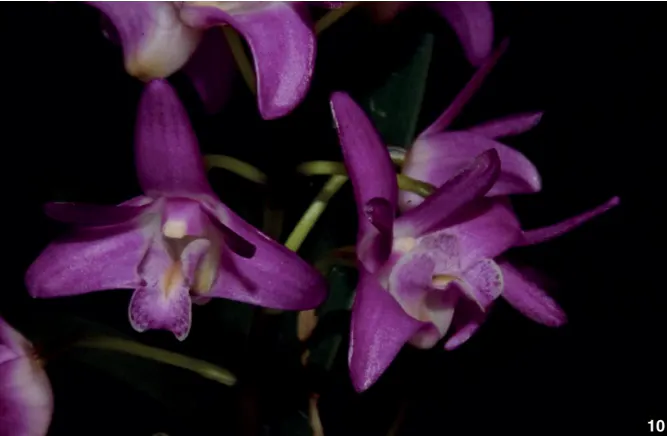
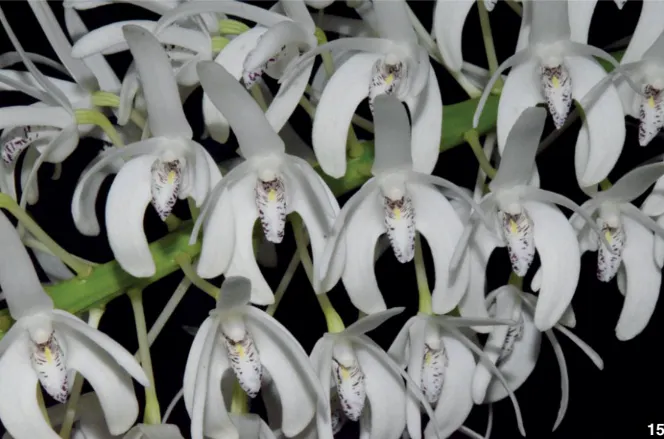
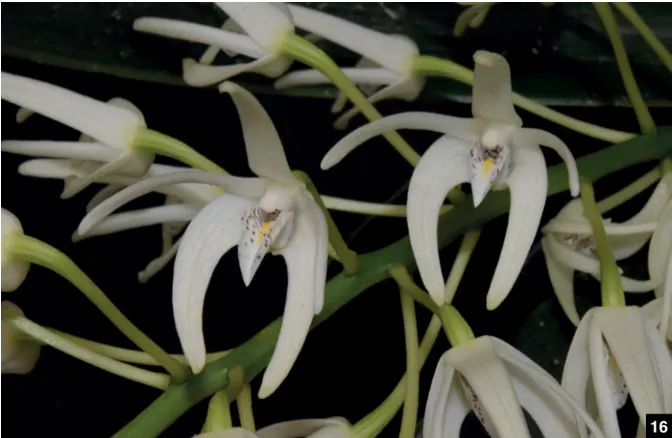
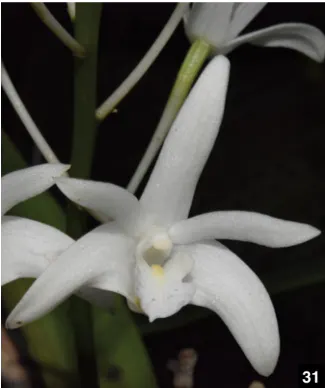
Plants identified in 2024/2025 as Fertile in Producing Den. Delicatum (Figs. 1–30)
The 2003 cross Den. (kingianum ‘Pale Dragon’ × speciosum [‘Windermere’ × self]) produced two quality, cream-pale-yellow-flowering plants, ‘Big Del 1’ and ‘Big Del 2.’ These were used to make Den. Delicatum in 2024 and 2025. Other Den. Delicatum that produced seedlings in 2025 were ‘Kerry,’ ‘Peter Bond’ and Den. × kestevenii ‘White 1017.’ In 2026, a much wider range of plants were trialed. The following Den. Delicatum were successful parents, with seedlings in flask — ‘Patricia’ (deep mauve), ‘Mark’ (white), ‘Dark Night’ (purple), ‘Harry Schultz’ (white), ‘Tracey’ (white), ‘Purple Delight’ (purple), ‘Big Del 1,’ ‘Big Del 2,’ as well as Den. ×delicatum ‘Rocky River.’ These represented about 15% of the crosses attempted, a low yield, but with potential for high-quality progenies.
[31] Den. ×delicatum ‘Rocky River Site’
A wide range of Den. kingianum were successful parents in 2025–2026. Previous crosses used mainly purple-flowering forms. These results showed that plants in most color categories produced seed capsules, and about half of the capsules had viable seeds. The flowering results are yet to be seen. There are many Den. kingianum, including unusual color combinations and miniature forms with large flowers, that could be trialed.
Characteristics of Key Breeding Plants
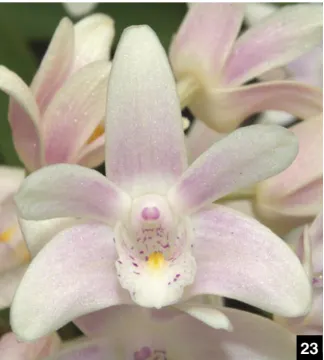
Den. Delicatum ‘Big Del 1’
One of the few quality plants from the P. and S. Adams 2003 crossing using Den. kingianum ‘Pale Dragon,’ an advanced line-bred splash-purple with Den. speciosum var. speciosum. It is a very robust, short-caned, compact plant with stout racemes up to 8 inches (20 cm) long, longer than the canes. There are up to 15 large flowers of heavy substance, 1.6 inches tall × 1.5 inches wide (4.0 cm × 3.8 cm). The color is a combination of pale mauve and cream-yellow with a deep mauve on the reverse. It has been crossed with other Den. Delicatum and white Den. ×kestevenii, looking to produce a variety of colors.
[23] Den. Delicatum ‘Big Del 1’
Den. Delicatum ‘Big Del 2’
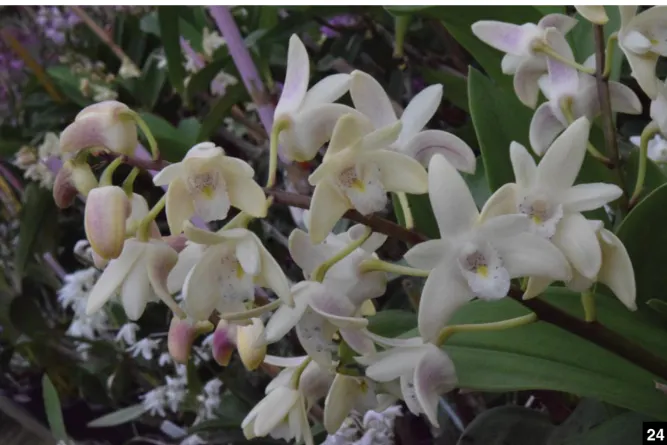
A medium-tall sibling of ‘Big Del 1,’ with long racemes bearing 18 cream-colored, large flowers of heavy substance, 1.7 inches (4.2 cm) tall and wide. It has produced seed in crosses with other Den. Delicatum.
[24] Den. Delicatum ‘Big Del 2’
Den. Delicatum ‘Cathie White’
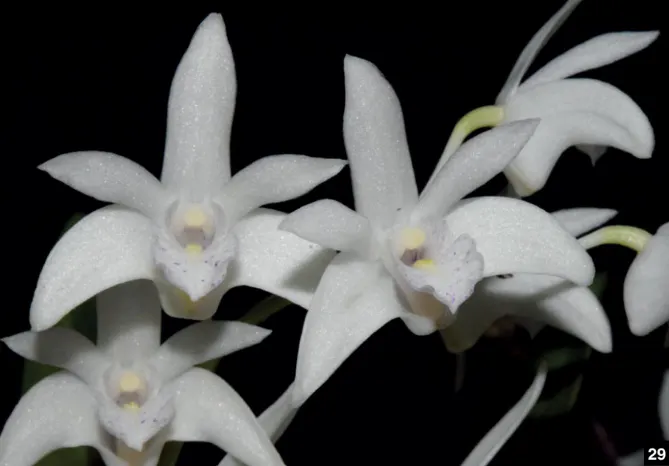
A tall, very floriferous, upright plant with long racemes up to 12 inches (30 cm), bearing 18 or more white, well-presented large flowers up to 1.5 inches (3.8 cm) high and wide. It forms a large specimen and has been successful in crosses with other Den. Delicatum. It is most likely from the Ira Butler 181 cross.
[29] Den. ×delicatum ‘Cathie White’
Den. Delicatum ‘Dark Night’
A medium height, floriferous plant bred by Wayne Turville (Australian Orchid Nursery) using a deep purple Den. kingianum ‘Darkie’ and Den. speciosum ‘Windermere.’ The very stout cane bases taper strongly toward the apex. The erect racemes are up to 10 inches (25 cm) long, with up to 20 small but well-presented deep splash-purple flowers up to 1.2 inches (2.9 cm) wide. It was crossed with larger-flowering Den. Delicatum, aiming to produce floriferous plants with good raceme habit and strong colors.
Den. Delicatum ‘Harry Schultz’
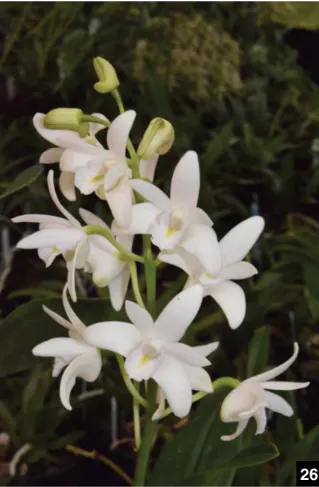
A medium height, urn-shaped plant with racemes about as long as the canes, up to 8 inches (20 cm). It is very floriferous, with 1–3 (mostly two) racemes up to 7.6 inches (19 cm) long per cane, with up to 15 well-presented flowers. The flowers are medium-sized, well-shaped, and white with a prominent contrasting green callus.
The origin is uncertain, but it is likely to have been bred by Ira Butler. In 2025, it crossed with several other Den. Delicatum producing seed capsules.
[26] Den. ×delicatum ‘Harry Schultz’
Den. Delicatum ‘Kerry’
A very well-known, moderately tall plant from the Ira Butler 181 cross that grows to specimen size and was a show winner for many years. It is very floriferous and has long arching racemes up to 9.6 inches (24 cm) long with 15 or more rich pink-mauve flowers of excellent quality. It is still grown in collections and has been crossed with several other quality Den. Delicatum.
Den. Delicatum ‘King of Kings’
A medium-tall plant with stout canes and long erect racemes to 10 inches (25 cm), with 10 or more well-presented deep purple flowers of medium size. There may be two racemes per cane. It was produced by Peter Miller. Parentage is a deep-purple early line-bred Den. kingianum (‘Red Devil × ‘Red Ink’) and an intervarietal Den. speciosum (‘Windermere’ × ‘curvicaule AB’). It formed seed capsules in 2025 when crossed with other Den. Delicatum.
[25] Den. ×delicatum ‘King of Kings’
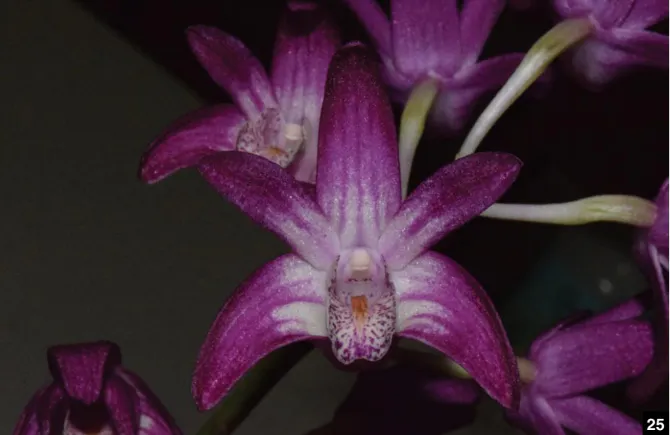
Den. Delicatum ‘Patricia’
A tall, upright, robust plant with erect, long leaves and very long arched racemes, often two per cane, to 13.2 inches (33 cm) long, bearing up to 27 large (to 1.9 inches [4.7 cm] wide) mauve-pink flowers, the most seen on a Den. Delicatum in recent years. It was bred by Tinonee Nursery from Den. kingianum (‘Red Devil’ × ‘Red Ink’) and an intervarietal Den. speciosum ([‘National White’ × ‘Windermere’] × ‘Daylight Moon’). In 2026, it was crossed with several Den. Delicatum and was the most fertile.
Den. Delicatum ‘Purple Delight’
A medium height plant from the same cross that produced ‘King of Kings,’ not yet fully mature, with racemes as long as the canes, bearing eight well-presented deep purple flowers with a white center. In 2026, it crossed with other deep purple Den. Delicatum from a different line.
Den. Delicatum ‘Tracey’
A medium height plant with long racemes bearing pure white flowers of high quality, more than 20 per raceme and often with two racemes per cane. The well-presented racemes arch downwards, creating a cascade effect with large flowers up to 1.9 inches (4.7 cm) in diameter. It crosses with other Den. Delicatum and is likely to transmit a variety of colors. It has been in collections for many years and is almost certainly an Ira Butler cross.
Den. ×delicatum ‘Apple Blossom’
A tall, naturally occurring hybrid that has been used since the 1960s to make Den. Delicatum and registered secondary hybrids. It has unusual mauve-green-colored flowers and is preferred by breeders because it is an excellent grower and is more fertile than Den. Delicatum.
[33] Den. ×delicatum ‘Apple Blossom’
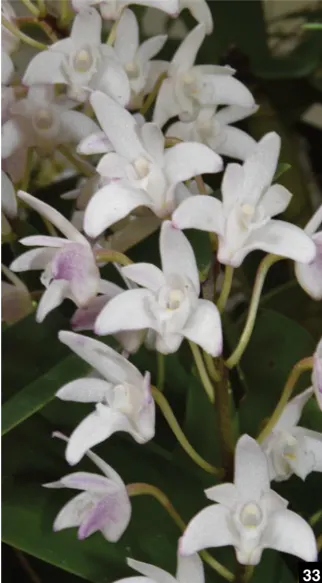
Den. × kestevenii ‘Buff’
A natural hybrid from Mt. Alum with var. speciosum parentage, that has been traced back to Dr. Kesteven’s original collection. The flowers have an unusual cream-tan color (buff) and are of medium size, 1.3 inches (3.2 cm) in diameter, and good shape. Racemes are up to 9.6 inches (24 cm) long with ≥16 flowers. It has been used successfully in breeding for many years, but the progenies have been difficult to locate.
[34] Den. ×kestevenii ‘Buff’
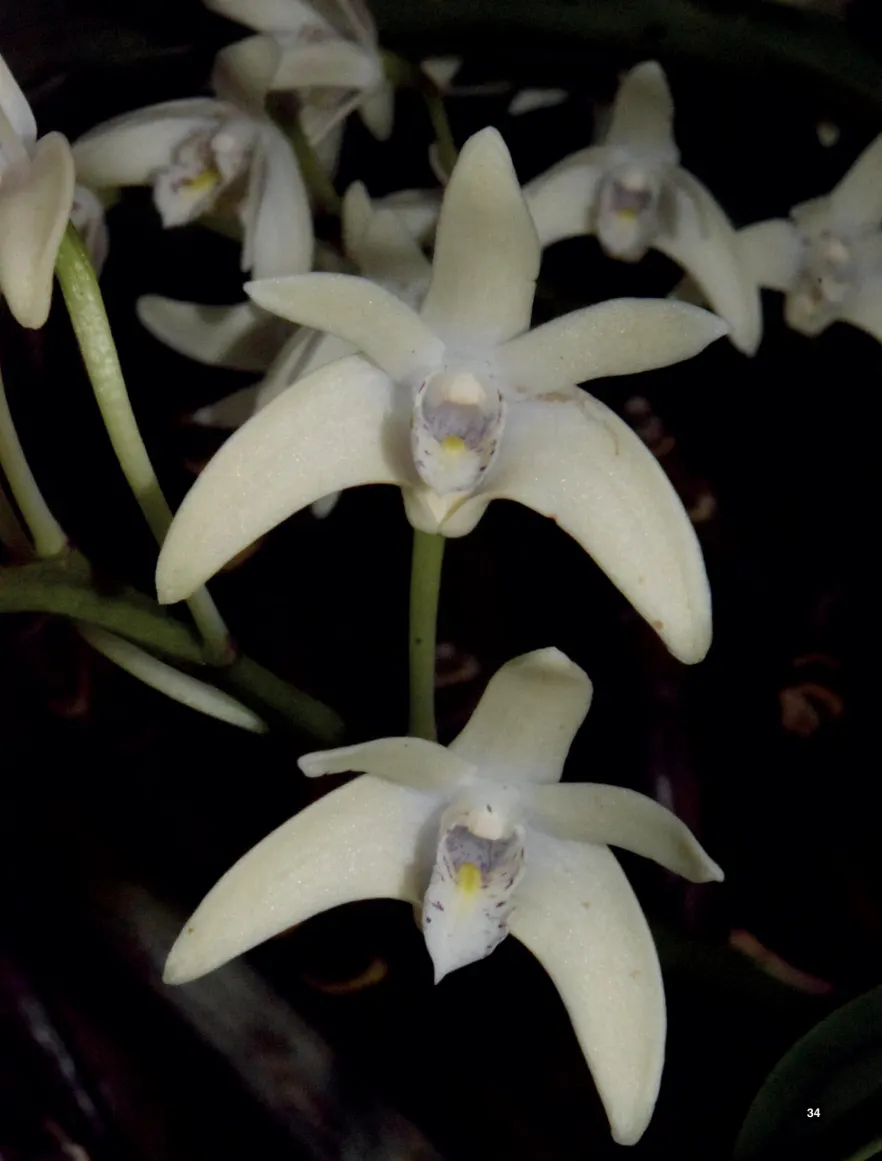
Den. ×kestevenii ‘White 1017’
This is a tall, compact, natural hybrid from Mt. Alum with canes 10.4 inches (26 cm) or more long. The gently arched racemes are about 10 inches (25 cm) long with 22 or more quality pure white flowers, up to 1.6 inches (3.9 cm) in diameter with rounded segments. It has been crossed with other Den. ×kestevenii and with Den. Delicatum.
[32] Den. ×kestevenii ‘White 1017’
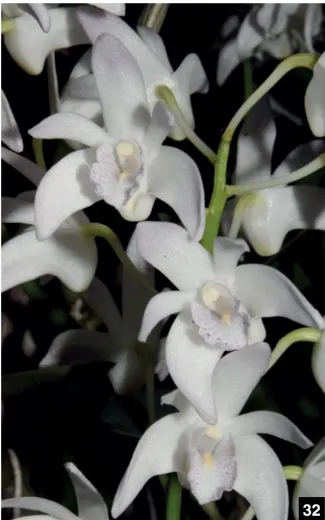
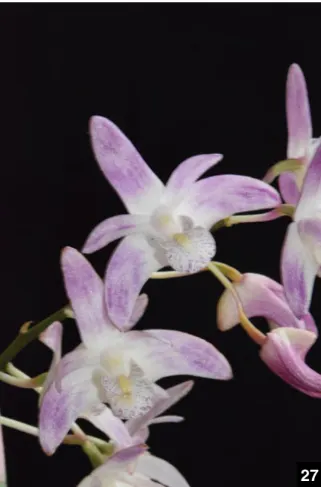
[27] Den. ×delicatum ‘Joy Bells’
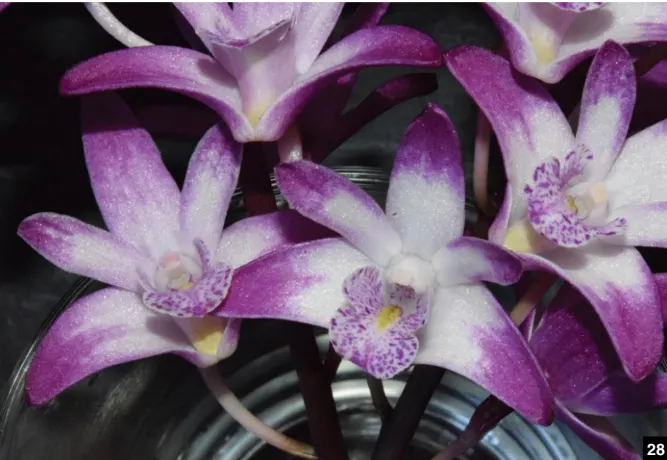
[28] Den. ×delicatum ‘Red Heart’
Historic Plant Rescues, Collections and Lessons for Breeding
It is rewarding to search out and assemble a collection of historic plants along with valuable historic information that seemed at first to have largely disappeared. Much information about plants and breeders has never been recorded, and much has been lost. Using a large network of friends and associates along the eastern Australian coast, a surprising number of valuable breeding plants were recovered. They were then trialed to find those that were fertile. These plants could be the key to a renewed breeding program to develop high-quality exhibits. The project generated much historical information and interest from growers who may remake secondary hybrids with superior parents.
The long-term viability of special plant collections and their maintenance is problematic, especially with private enthusiasts and institutions such as botanic and public gardens. Changes in administration, staff, policy and funding mean that survival of public collections cannot be guaranteed. The plan for the rescued historic collection of Den. ×delicatum and Den. Delicatum plants is to establish an ongoing site where there is at least one researcher using them, and to distribute them to committed private growers who hopefully will grow them and distribute them further.
Orchid growing can be too much about fashion and striving for differences, variety and quality, with insufficient attention to preserve and use the best of what is already generated. Using the best breeding plants from the past has the potential for advances. Some of the failures and difficulties experienced in the past may be overcome with a targeted approach. About 20 years after a marked decline in interest in Den. Delicatum, some plants were still recoverable, and this has led to a significant resurgence of interest.
The early breeders of Australian hybrids were more successful than has been recognized. Very little was recorded at the time about the plants, breeders and methods used. There may be more neglected plants still in collections. Other dendrobiums and other genera likely have historic plants in a similar precarious position, and it is not too late to take action.
References and Further Reading
Adams, P.B. 1988. The Spectrum of Fertility in Australian Orchid Species. In: Adams PB (edit) Reproductive Biology of Species Orchids. School of Botany, The University of Melbourne and Orchid Species Society of Victoria, p 25–35.
2025. A Review of Dendrobium × delicatum, Artificial Hybrids of Den. kingianum × Den. speciosum, and the Status of Den. Speckioniganum (Orchidaceae) Telopea 29:163–171.
Rupp, H.M.R. 1943. The Orchids of New South Wales. Flora of New South Wales, National Herbarium, Sydney.
Upton, W.T. 1989. Dendrobium Orchids of Australia. Houghton Mifflin. Australia
— Peter Adams researches the evolution and relationships of Australian dendrobiums and authored the 2023 AOS Supplement Dendrobium kingianum. Line Breeding and Hybrids. He is a member of three Australian judging panels including the Australian Native Orchid Society (ANOS), is past president of ANOS, and current president of ANOS Melbourne Suburbs Group. School of Biological Sciences, University of Melbourne and National Herbarium, Royal Botanic Gardens, Melbourne (email pbadams45@gmail.com).