

The best way to prevent diseases in orchids is to grow strong healthy plants that are able to use their natural defense mechanisms to protect themselves. Orchids do not have an immunological system like we do. They have a phloem that transports the sugars produced in the leaves by photosynthesis through the rest of the plant and a xylem that transports water and soluble mineral nutrients absorbed from the roots upwards throughout the plant, but they don’t have a circulatory system carrying leukocytes, lymphocytes, antibodies and all the rest of our incredible infection fighters. So how does an orchid protect itself from disease?
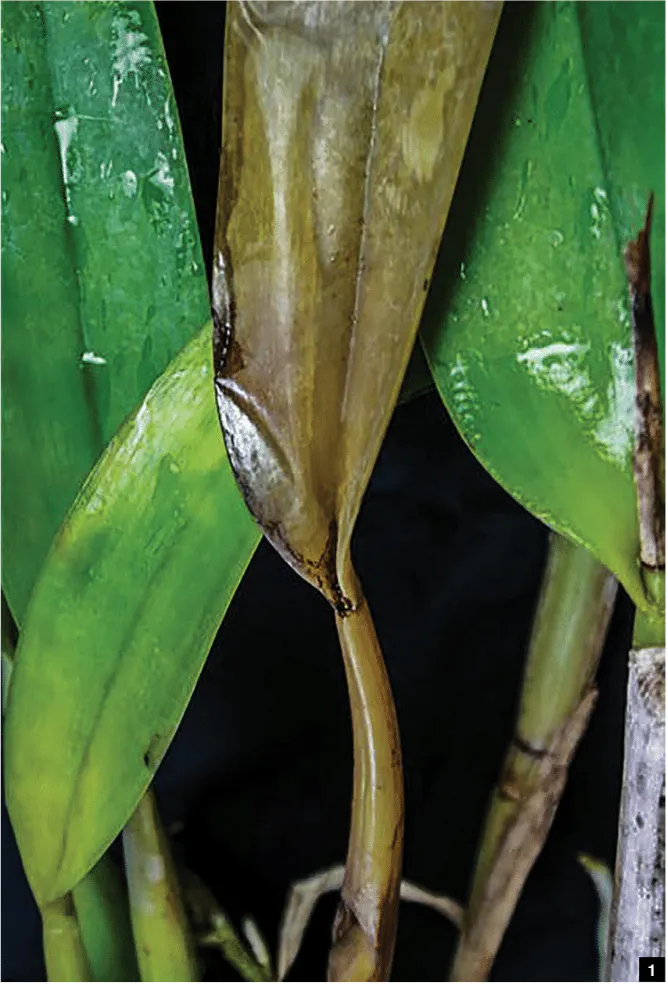
[1] Black rot on a cattleya. Supplying your plants with sufficient calcium will strengthen them so they can more easily withstand attack by the water molds that cause black rot, although those suffering through hot humid summers may also have to rely on heavy-duty fungicides to protect their plants.
THE NATURAL DISEASE RESPONSE IN ORCHIDS — WALL OFF THE INVADING PATHOGENS
Barrier to Entry
Orchids have an epidermis with an outer layer called a cuticle that consists of a wax-like substance that provides protection against water loss as well as a barrier to entry, acting as the first line of defense against pathogens. Some fungi can pierce this barrier by secreting an enzyme that degrades the cuticle. Bacteria and some fungi circumvent the barrier by entering tissues through open stomata or wound sites.
Hypersensitive Response
When an attack by a pathogen begins, plants respond with a rapid series of events at the site of the infection that culminates in the hypersensitive response. This is a localized death of cells at the site of infection as a result of the plant cells recognizing the invading pathogen and committing suicide to thwart the pathogen. The dead cells wall off the pathogen and this necrotic barrier prevents the transmission of the pathogen through the plant. These dead cells may also become hard and unattractive to other pathogens by producing toxic compounds.
Systemic Acquired Resistance
The initial hypersensitive response is commonly followed by a slower response that leads to systemic acquired resistance. Systemic acquired resistance occurs when a chemical travels from the infection site to nearby tissues via the phloem and primes the rest of the plant to protect itself against further challenges from the invading pathogen. The plant’s response to the infection in one leaf causes the plant to become more resistant to a secondary attack in a different part of the plant.
SUBSTANCES THAT MAY INDUCE A PLANT’S RESPONSE TO DISEASE — ARTIFICIAL STIMULATION OF THE PLANT’S RESPONSE MECHANISM
Aspirin
Salicylic acid (a chemical related to aspirin) is one of several chemicals that can transmit the signal of the defense response throughout the plant. Studies have shown that applying salicylic acid to plants can induce resistance to pathogens, environmental stresses and some insects. Well known Fort Lauderdale orchid grower Dot Henley wrote about her experience applying aspirin (methyl salicylate) to her orchids in the October 2001 edition of the AOS Bulletin (Henley 2001). She reported that her plants had more flowers, bigger growths and fewer fungal problems after weekly spraying with a fertilizer solution to which aspirin was added (¾ of a 325-mg aspirin in a gallon [3.785 L] of water). She later added two caveats: do not exceed the recommended amount and do not skip adding aspirin to your fertilizer regimen for more than a couple of weeks because the orchids seem to become addicted to aspirin and fungal and bacterial problems may occur without their weekly fix.
Harpin Proteins
A naturally occurring protein isolated from bacterial plant pathogens has been shown to initiate the protective response in plants when applied to leaves. Plants can detect the presence of these harpin proteins and their early warning system is activated. The plant thinks it is under attack and signals other parts of the plant to activate defensive and growth responses. Rx Green Solutions markets Axiom, the harpin alpha beta protein, and recommends it be applied every 2 to 3 weeks at a rate of a 2-gram packet per gallon (3.785 L) as a foliar application via a light mist. The potential effectiveness of harpin proteins for orchids is currently under evaluation in the scientific community.
Biological Agents
Biological control agents are introduced, or resident, living organisms that suppress the activities and populations of plant pathogens. They are most effective if applied prior to infection. Biological control agents may work by killing the pathogen, producing a compound that is toxic or interferes with pathogen growth, triggering a defensive response in the host plant or out-competing the pathogen. The soilless Promix HP has a biofungicide incorporated into its mix, naturally occurring strains of bacteria (Bacillus subtilis, Bacillus pumilus) reported to enhance plant growth and suppress harmful organisms such as Fusarium, Pythium and Rhizoctonia. There are a variety of other products containing Streptomyces lydicus, Bacillus subtilis, Trichoderma species and Gliocladium virens that claim to help prevent some soil-borne diseases and aerial diseases if applied prior to the disease occurring in the growing area.
WOUND MANAGEMENT AND PROTECTIVE SPRAYS — KILL PATHOGENS IN THE ENVIRONMENT BEFORE THEY INFECT YOUR PLANT
There are a number of chemicals available to protect your plants from bacterial and fungal infections, although they are most effective as protectants rather than curatives. There are many precautionary treatments you can incorporate into your growing regimen. Regular disinfection of your growing area by spraying with sterilants such as bleach or quaternary ammonium compounds is a good start. Many orchid growers dust open wounds on their plants with cinnamon or a fungicide to seal wounds and prevent infection. After repotting, I pour a protective drench of Banrot 40WP through the fresh potting mix to ward off infection, plus some seaweed extract to encourage root growth. Some spray specific types of plants for a specific potential problem, like monthly sprays with thiophanate methyl (Thiomyl or Clearys 3336) to control Guignardia in vandas and a post-repotting and fall spray of copper compounds to help prevent Erwinia (now called Pectobacterium) in phals and paphs.
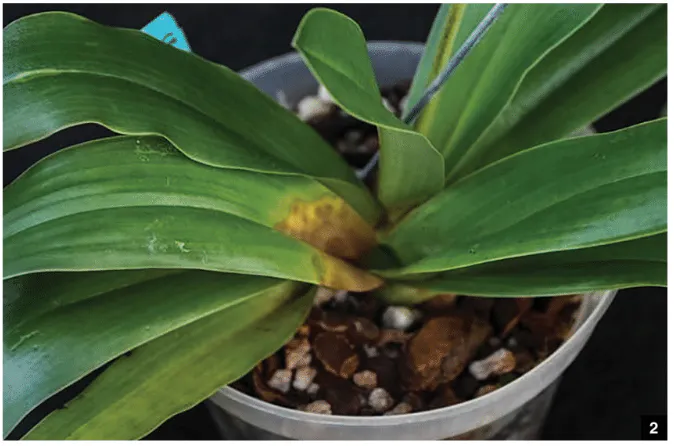
[2] Occasional preventative treatments can help. I spray out-of-bloom phalaenopsis and paphiopedilums twice a year with copper compounds, after repotting in the summer and before the cool season in the fall, to help prevent bacterial infections from Erwinia (now Pectobacterium).
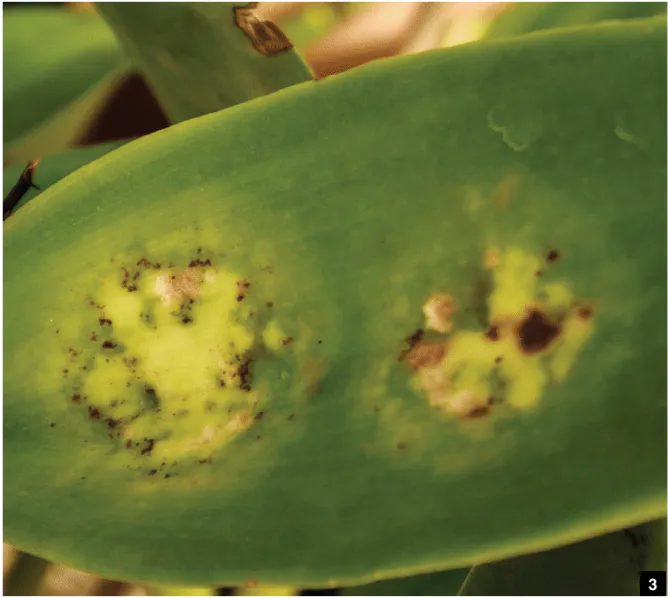
[3] Good air movement is one of the most effective ways to prevent a disease from infecting your plant, like this Cercospora damage on a cattleya. Fresh air constantly bathing the leaves, together with good spacing between plants, will help prevent a disease from gaining a stronghold in your growing area.
GOOD CULTURAL PRACTICES — YOUR BEST DEFENSE AGAINST ORCHID DISEASE IS A VIBRANTLY GROWING PLANT THAT CAN RESIST INFECTION
Your best defense against orchid disease is to optimize your culture so your orchids are healthy and happy and able to resist diseases naturally. This means you must provide your plants with enough of the right kinds of light, water, nutrients, warmth and air movement and make sure your potting media is fresh. The importance of providing fresh air for your plants cannot be overemphasized. Fresh air will only work its wonders if there is sufficient spacing between plants. Sanitation is vitally important to eliminate the sources of pathogens in your growing area. Maintain a clean growing area free of weeds, which often harbor disease. Remove spent flowers and fallen leaves from the growing area to a sealed container to remove the source of infections. Disinfect benches and under benches regularly to kill any lingering pathogens. Sterilize cutting tools, pots, wire products and similar tools before reuse so problems aren’t transferred from one plant to another. Always use new or sterile potting medium. Don’t allow water to drip from one plant to another and never dunk plants in a common bucket. Make sure your new orchids are healthy, and disease-free before introducing them to your growing area. When you water, look at each plant for any signs of stress, particularly as seasonal changes in temperature, light and moisture occur. Consider developing a schedule for preventative applications of fungicides or bactericides suitable to your climate and growing conditions.
Many disease problems can be prevented with attention to sanitation and good cultural practices. Occasionally you may find you have a genetic weakling that is prone to problems. I tend to discard these unless the flower is extraordinary. All growers will find disease in their collections from time to time and have to resort to the use of fungicides and bactericides to control a problem. If you have a recurring disease problem, there may be some aspect of your cultural practices that should be changed or perhaps you are trying to grow a plant not well-suited to your growing conditions. Your plants will be happiest if you focus on improving your culture rather than reflexively spraying chemicals on them whenever you notice a new leaf spot.
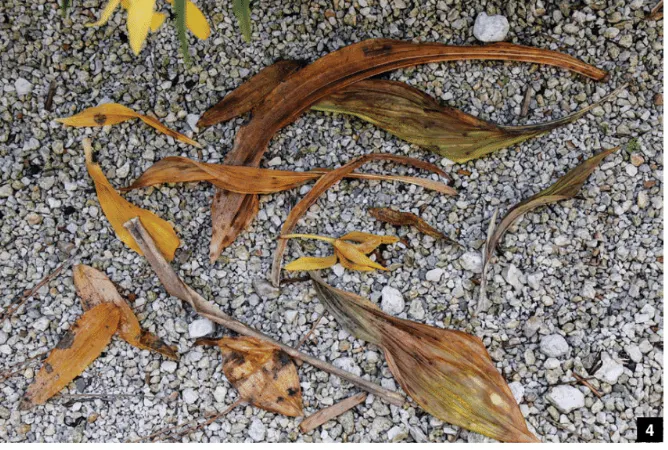
[4] Don’t be this grower! Never allow spent flowers or vegetation to linger in your growing area. Spores and other inoculum for future infections are growing on these dead plant parts. Promptly remove them from the growing area to a sealed container for disposal; no composting!
References and Additional Reading
Chuang, H.W., P.Y. Chang, and Y.Y. Syu. 2014. Harpin Protein, an Elicitor of Disease Resistance, Acts as a Growth Promoter in Phalaenopsis Orchids. Journal of Plant Growth Regulation 33:788–797.
Freeman, B.C. and G.A. Beattie. 2008. An Overview of Plant Defenses against Pathogens and Herbivores. http://www. apsnet.org/edcenter/intropp/topics/ Pages/OverviewOfPlantDiseases.aspx. Accessed November 15, 2015.
Freeman, S., K. Quillin, and L. Allison. Chapter 37, Plant Defense Systems. p. 709–725. In: Biological Science. 4th ed. Prentice Hall, Upper Saddle River, New Jersey. http://www.pearsoncustom. com/ucsc/images/0130819239_ch37. pdf. Accessed May 26, 2014.
Guest, D. and J. Brown. 1997. Plant Defences against Pathogens. Plant Pathogens and Plant Diseases 263–286. http:// www.appsnet.org/Publications/Books/ Brown_Ogle/17 Defence mechanisms (DIG&JFB).pdf. Accessed May 26, 2014.
Harmon, P.F., S.D. Bledsoe, and R.J. McGovern. 2004, revised 2012. Professional Disease Management Guide for Ornamental Plants. University of Florida Extension, Publication PP-202.
Henley, D. Aspirin and Growing Orchids. Orchids 70(10):983.
Pal, K.K. and B.M. Gardener. 2006. Biological Control of Plant Pathogens. The Plant Health Instructor 2:1117–1142.
Raskin, I. 1992. Salicylate, A New Plant Hormone. Plant Physiology, 99:799–803.
— Sue Bottom started growing orchids in Houston in the mid-1990s after her husband Terry built her first greenhouse. They settled into St. Augustine, Florida, Sue with her orchids and Terry with his camera and are active in the St. Augustine Orchid Society, maintaining the society’s website and publishing its monthly newsletter. Sue is also a member of the AOS Publication Committee (sbottom15@hotmail.com).