

In October, buds can be seen or felt in the fall- and winter-flowering paphiopedilums. This group will come into its own, making a wonderful display by December. Some of the white paphiopedilums and a few of the earlier colored hybrids may be flowering, but it is early for the main display. Be careful that water does not stay in the crowns on cool nights. Once buds are formed, they are easily rotted.
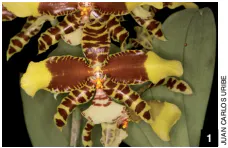
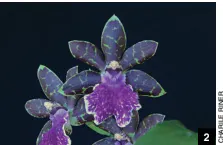
October is also the month that Rossioglossum grande puts on a “grand” display. Give it a good resting period after flowering. This is also the flowering season for Zygopetalum maculatum (mackayi and intermedium are synonyms) hybrids.
[1] Rossioglossum grande ‘Juan’ AM/AOS; exhibitor: Ivan Bolaños.
[2] Zygopetalum intermedium ‘D&D’ HCC/AOS; exhibitor: Debbie Williams.
October is cattleya month! It can truly be said that the greatest assortment of the jewels of the Cattleya Alliance bloom this month. A few yellows are still in flower, but now the limelight has been taken over by the large-flowered whites and white-with-colored lip hybrids, and the bifoliate cluster-type purples. The majority of the bifoliate cluster-types have Guarianthe bowringiana in the background. There is no special treatment for these plants; they just grow. This good-growing characteristic is one of the reasons for using Gur. bowringiana as a parent. Many of the hybrids from larger- flowered Cattleya species have very littleroot action in the fall and winter, which is just the opposite of bowringiana.
[3] Guarianthe bowringiana ‘Kathleen’ AM/AOS; exhibitor: William Rogerson.
In the large Epidendrum Alliance, Epidendrum ciliare, with its curious fringed, exceptionally evening-fragrant flowers, makes a striking display this time of the year.
[4] Epidendrum ciliare ‘V.I. Gold’ AM/AOS; exhibitor: Rudy O’Reilly.
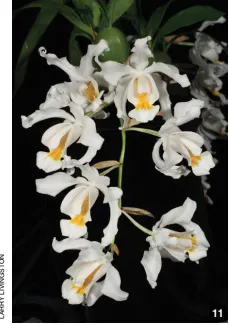
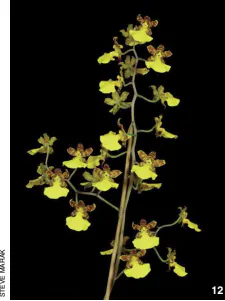
Later in the fall, and specifically the month of December, the species Cattleya percivaliana, Cattleya trianae and possibly Cattleya maxima will be in flower. One good, reliable Christmas flower is Laelia × gouldiana. The deep rosy-lilac color does not appeal to everyone, but it makes a good show. Give it plenty of light. It is a little early for the delightful little Laelia albida, but spikes should be showing. Other species, possibly in flower in late fall, are Lycaste virginalis and Coelogyne cristata, and if you have grown it warm, Trichocentrum splendidum can be had in flower for Christmas.
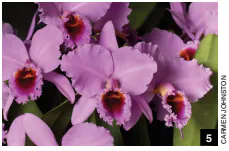
[5] Cattleya percivaliana ‘Lady Stella’ AM/AOS; exhibitor: Melida Demorizi.
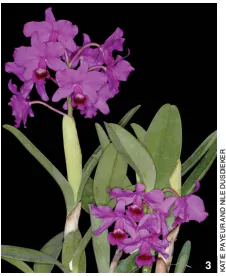
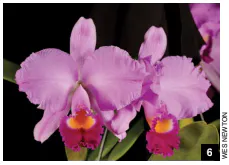
[6] Cattleya trianae ‘Isabel’ HCC/AOS; exhibitor: Michael Sinn – Canaima Orchids.
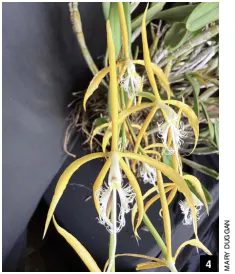
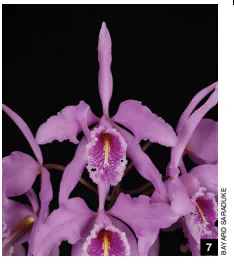
[7] Cattleya maxima ‘Gorgeous’ AM/AOS; exhibitor Bayard Saraduke.
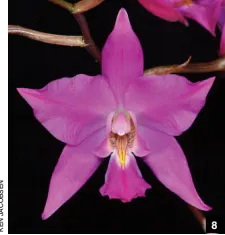
[8] Laelia ×gouldiana ‘Samaria Skye’ HCC/AOS; exhibitor: Sylvia Darr.
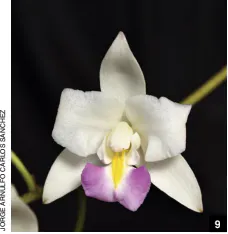
[9] Laelia albida (Semialba) ‘Juan Emilio Reyes’ HCC/AOS; exhibitor: Anagracia de Reyes.
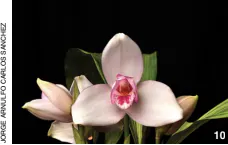
[10] Lycaste virginalis ‘Jaqueline Molina’ AM/AOS; exhibitor: Alejandro Bolaños Molina.
[11] Coelogyne cristata ‘Suwada’ HCC/AOS; exhibitor: Barbara Vander Stoep.
[12] Trichocentrum splendidum ‘Desert Sands’ AM/AOS; exhibitor: Kay Backues.
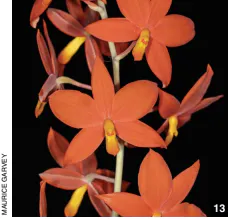
Prosthechea vitellina, with its brilliant orange-scarlet flowers, may be in flower. They seem to prefer conditions similar to the former odontoglossums, which include: bright light in an east window or a shaded south window. Western exposures are usually too warm in most climates; day temperatures below 75–80 F (24–27C) are almost essential year-round, and night temperatures of 55–58F (13–14 C) are best; water should be plentiful, coupled with perfect drainage. The potting medium should just begin to dry before watering; humidity, coupled with moving air, should ideally be 40–80 percent. Set the plants on trays above moist pebbles, with the pots resting above the water; fertilize regularly with a dilute solution while plants are actively growing. Follow this growing advice, and their flowers last and last.
[13] Prosthechea vitellina ‘Abigail’ AM/AOS; exhibitor: Dave Taft.
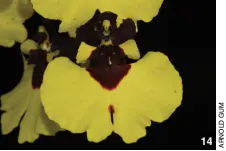
Also in the section of cool-growing orchids is the glorious Gomesa varicosa with clouds of “dancing doll” flowers of yellow and brown with huge “ballet skirts” of yellow.
[14] Gomesa varicosa ‘Felicio Valdiño’ AM/AOS; exhibitor: William and Margaret Loy.
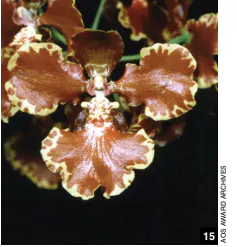
Speaking of cool growers, Gomesa forbesii with its handsome, wavy chestnut-brown flowers with narrow margins of yellow should be in flower now. Dendrobium species and hybrids in sections Phalaenanthe and Spatulata (so-called Phalaenopsis- and Antelope- types) make a good show at this time of the year.
[15] Gomesa forbesii ‘Marron Glace’ AM/AOS; exhibitor: Pat and Ginny Worthington.
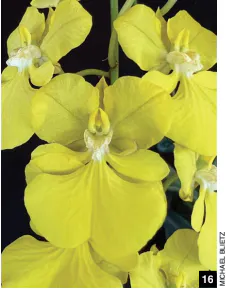
Zelenkoa onusta should flower about now. It requires plenty of heat while growing and will make its growths very quickly. When growths are mature, they should then have a long dry rest, preferably with cooler temperatures.
[16] Zelenkoa onusta ‘Glossy Yellow’ AM/AOS; exhibitor: Exotic Orchids of Maui, Inc..
December is possibly the hardest month for the beginning orchid grower. Except the Deep South and Hawaii, where temperatures are still warm and relatively long days allow more “normal” growing conditions, restraint in watering, ventilation, feeding and potting are all necessary. Over-watering should be avoided. If in doubt, do not water — ALWAYS err on the side of a bit too dry. More orchids are killed by over-watering than by under-watering! Your finger is one of the best devices for measuring moisture in the medium. Stick a finger into the medium about an inch (2.5 cm) and feel the moisture level. If it feels wet, wait a couple of days; if it feels like the Sahara Desert, you have waited a few days too long.
With a good all-round collection, your growing space need not be dull. Tying and staking all mature orchid growths are good jobs for December. Paphiopedilum flowers may need supporting, and handy supports can easily be made with wire and a pair of pliers. Support early so that the flowers can be displayed to their best advantage. Early Cymbidium spikes may also need a stake — and if you have slugs, wrap a piece of cotton around the stem and stake. Slugs and snails can be a problem if you grow outside. Slugs and snails hate caffeine, researchers have discovered. They have found that a 1–2% caffeine solution kills most of the slugs and snails in a couple of days. Concentrations as low as 0.01 percent repelled the pests. A cup of instant coffee contains about 0.05 percent caffeine, and brewed coffee has more. Coffee grounds can also be used to repel slugs and snails, but a caffeine solution is much more effective. Caffeine is more effective against slugs than toxic metaldehyde products. The United States bans metaldehyde residues in food, but classifies caffeine as safe. It may even qualify as organic. Diluted coffee is also an excellent organic fertilizer, especially for orchids. Coffee grounds are basically free. Just ask your local restaurants or coffee shops to put them in a container provided by you. At least, save and use your own coffee grounds. You should also continue to treat for other pests and diseases. Home remedies can work if you are diligent: For soft-bodied bugs, such as aphids and mealybugs, you can use straight 70–90 percent isopropyl rubbing alcohol — touch insects with a soaked cotton swab, or for larger infestations, spray the entire affected plant, being sure to thoroughly wet all surfaces. Repeat every three days for about two weeks. You can also use peppermint oil and castile liquid soap (available at health food stores), which makes safe, effective pest control. Dilute 1 tsp/qt of water (4.75 ml/liter) in a hand sprayer and spray infestations every few days until controlled. Another formula you can use is one cup (250 ml) each of Formula 409 or Fantastik household cleaner/ degreaser and isopropyl rubbing alcohol, and 2 cups (500 ml) water, making a quart or liter of spray. Orange Plus, a household cleaner made from byproducts of orange juice production, can be sprayed directly on plants to eliminate insects. You can also make your own citrus-based insecticide by steeping lemon, orange and grapefruit peels in water.