

When Dr. Courtney Hackney gave a presentation to our club, he showed a picture of a cattleya with a darkening pseudobulb and said it was due to a pathogenic rhizoctonia infection, and then asked if others had ever experienced this problem. In the picture he showed, the disease looked like black rot, but when Courtney said the tissue was hard rather than soft like it would be if it were black rot, I thought of some recent mortalities in my greenhouse.
The fungal disease Rhizoctonia solani slowly travels through the plant and can move up the lower part of the pseudobulb. If not controlled, the disease causes brown rot and eventually kills the plant.
Time for a little research. You won’t find much written about rhizoctonia and orchids. Rebecca Northen’s classic Home Orchid Growing (1990) contains a passing reference to this disease, stating “The brown mycelium infects the roots and progresses through the rhizome and the lower parts of the pseudobulbs.” Margaret and Charles Baker’s Orchid Species Culture (2006) series has an appendix dealing with orchid growing problems that contains a wealth of information and is very helpful in diagnosing problems. They describe Rhizoctonia solani as primarily a root disease, though the symptoms typically are first noticed on the aerial parts of the plant, which are shriveled, twisted and generally dehydrated, similar to what you would see if the plant were infected with fusarium. I then turned to William Cullina’s Understanding Orchids (2004) and looked at his pictures of a plant infected with rhizoctonia and had that “aha” moment. So that’s what’s been happening in the greenhouse!
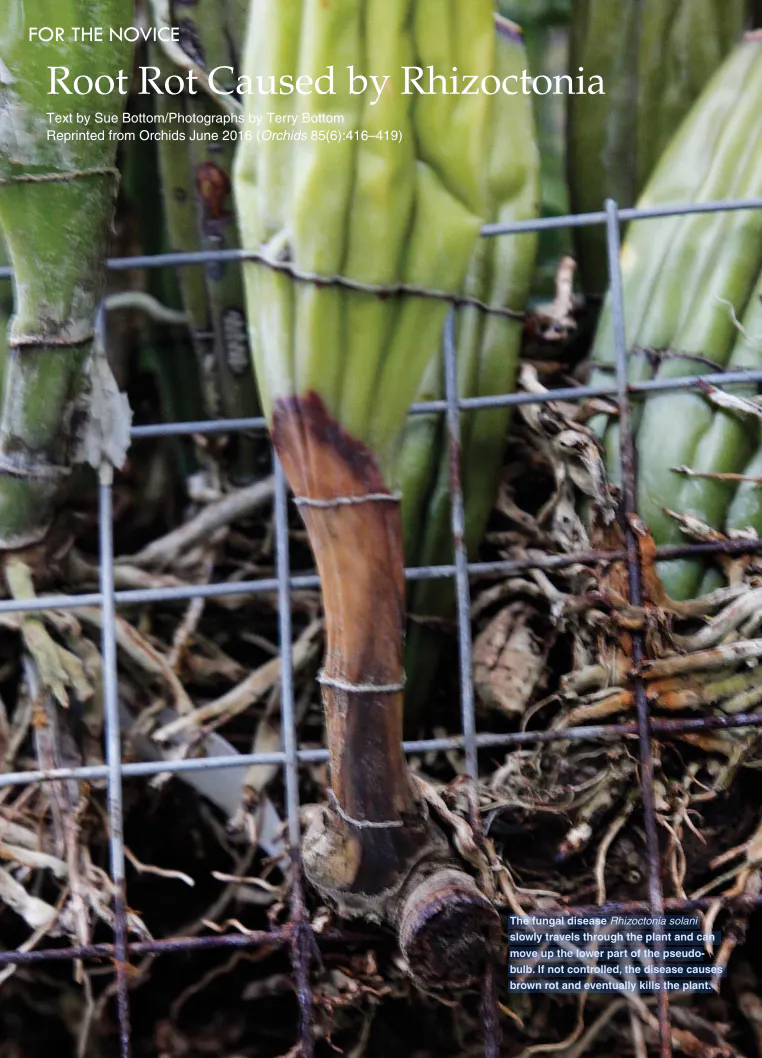
[1] This plant has a very severe case of rhizoctonia root rot, so advanced that there was no hope of saving it. The earlier symptoms of rhizoctonia are similar to those caused by fusarium. The leaves and pseudobulbs become yellow, shriveled, thin and may become twisted.
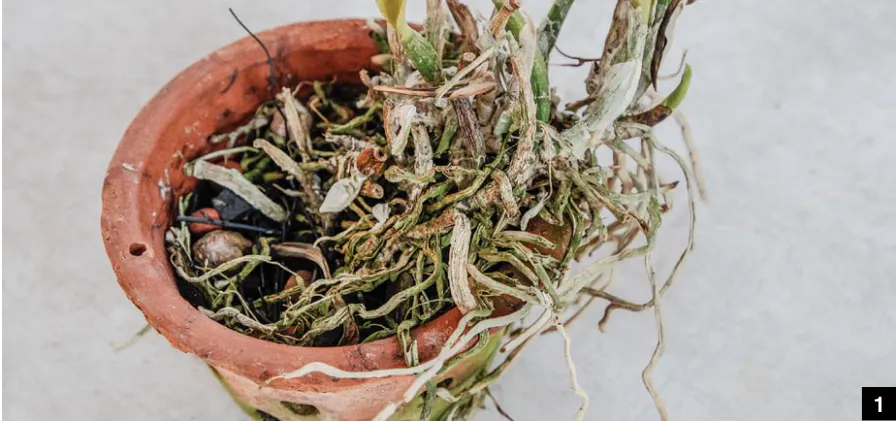
[2] You may think the damage from rhizoctonia root rot and black rot is similar, but there are many differences. This plant is infected by rhizoctonia, a slowly moving fungal disease that travels from the back toward the front of the plant and can move up the pseudobulbs causing brown rot, although the pseudobulbs are relatively hard and ultimately shrivel into papery husks.
Luckily that was the day Terry and Courtney went out fishing, so I knew the Good Doctor would be making a house call. I took off my blinders and inspected each plant on the greenhouse benches and pulled any that looked unhappy, shriveled as if dehydrated and wobbly in the pot. I arranged them on the table from the least to the most sickly and waited for the fishermen—I mean the professor and the photographer—to return. There were about a dozen cases of infected plants. Most required severe pruning and fresh potting mix, though there were a few that were so far gone they had to be discarded.
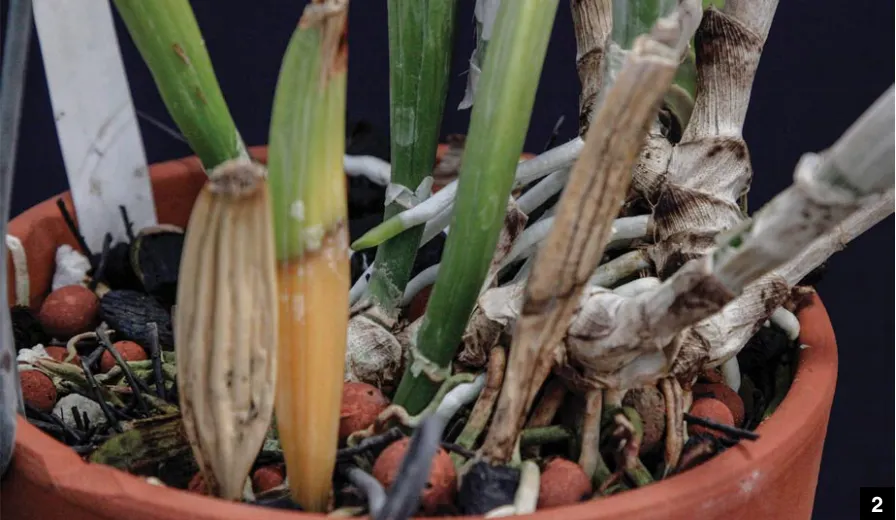
[3] This is a black rot infection, a very fast moving disease caused by water molds. The pseudobulbs darken and collapse in a matter of days and the plant will die unless immediate action is taken.
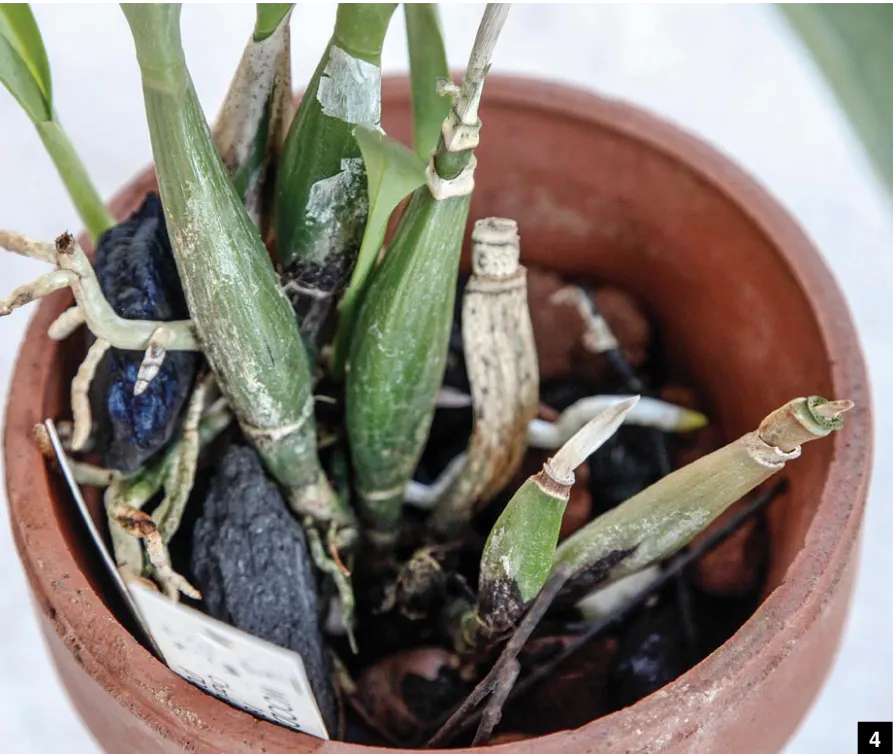
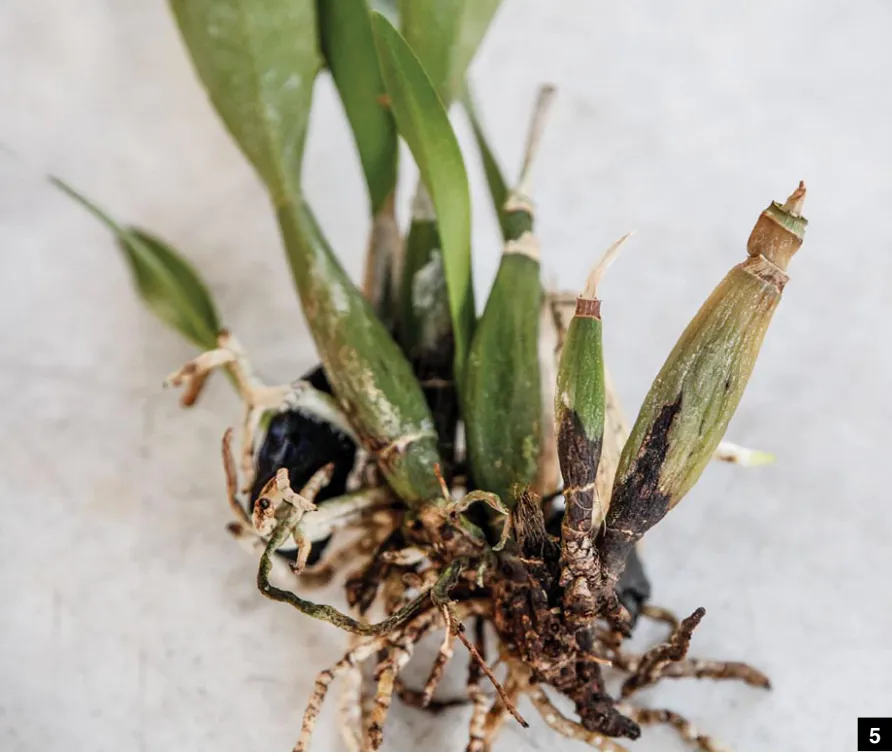
[4-5] An infected plant is very wobbly in the pot [4] and if you lift it out of the pot [5], you’ll see that the roots are dead starting at the oldest growth. The only live roots are those that are outside of the pot and potting mix. Severely degraded organic potting mixes can cause the roots to rot, but rhizoctonia populations can also build up in inorganic mixes or organic mixes that are relatively fresh.
Unlike the fast-moving black rot caused by Pythium and Phytophthora, the brown rot caused by Rhizoctonia solani causes a gradual deterioration of mature plants as the roots rot. Plants that are overwatered or that are in decomposing mix are especially vulnerable to this brown rot. The rot tends to occur in the oldest part of the plant and moves slowly through the rhizome toward the younger part of the plant. Eventually, you might notice a brown discoloration line creeping up the pseudobulbs that will eventually turn entirely brown, wither and die. Seedlings and compots can be killed quickly and the disease is called damping off.
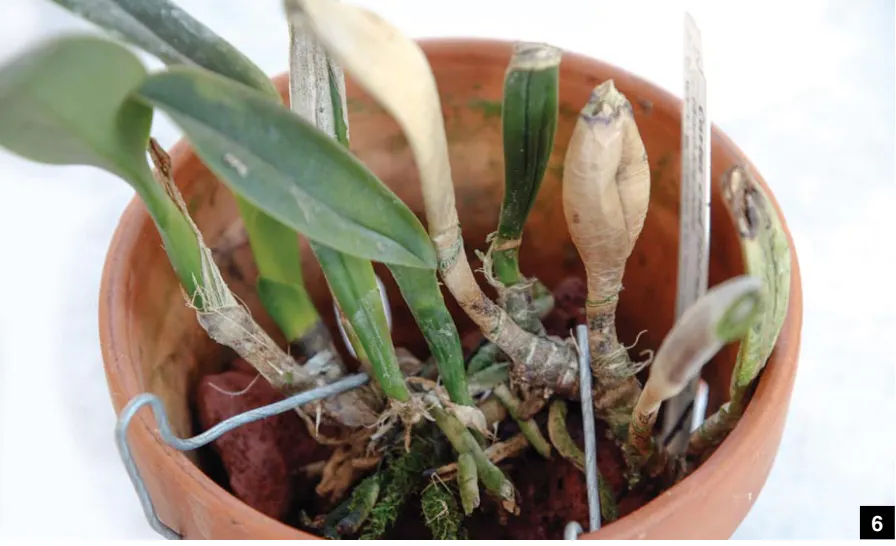
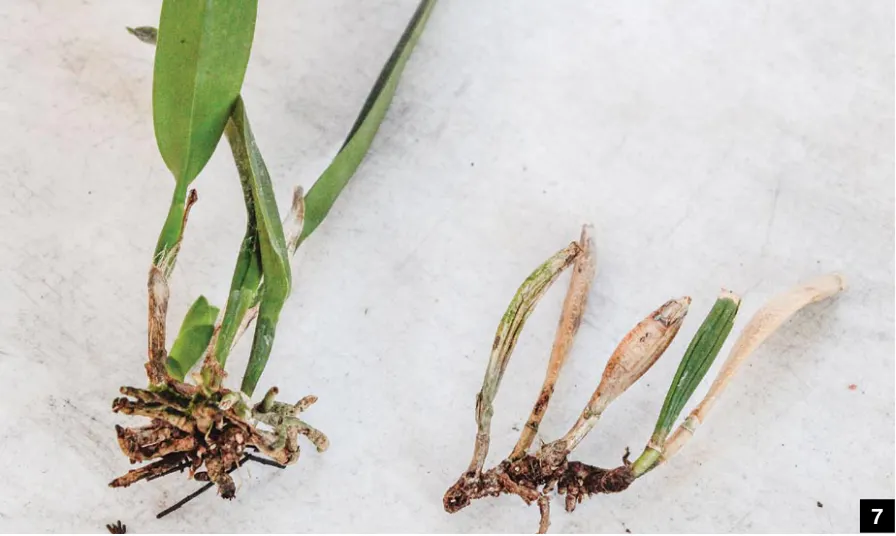
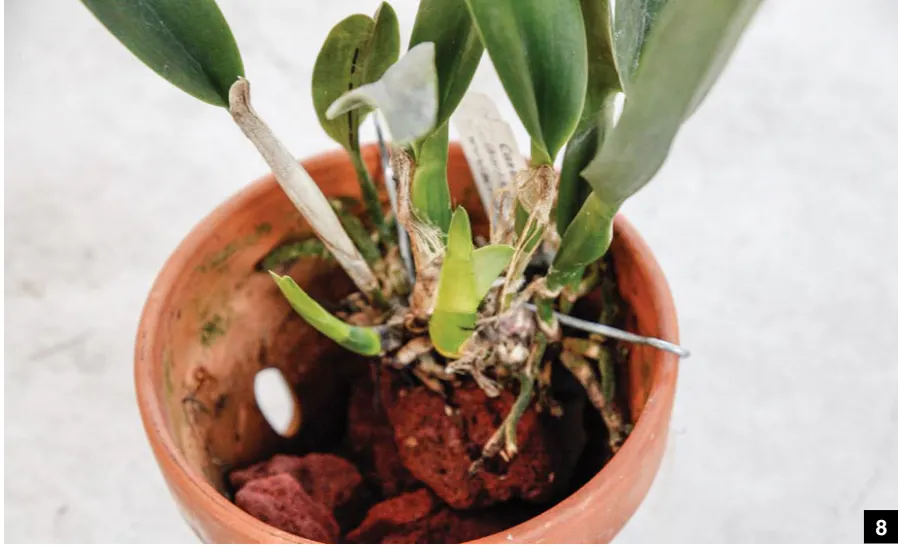
[6-8] You will most often notice the dying backbulbs as the disease progresses through the rhizome to the youngest part of the plant. The solution is to cut away the diseased parts of the plant and repot in fresh mix, applying a protective drench of a suitable fungicide through the potting mix. You can see the dying backbulbs in [6], the rootless back bulbs removed from the pot [7] and the repotted front pseudobulbs in [8].
When you find a plant that looks dehydrated, whose pseudobulbs are shriveled and yellowing or whose normally fat leaves are thin and limp, you know it’s time to knock it out of the pot and check the roots. It is possible that you have overwatered and drowned the roots, particularly if the plant was potted in a water-retentive mix. The potting mix could be degraded which caused the roots to rot or the roots may have rotted because the rhizoctonia fungal population has exploded. Your solution is the same in either case: repot in fresh mix and then drench the potting mix with a protective fungicide, such as a relatively affordable fungicide containing the active ingredient thiophanate methyl (e.g., Cleary’s 3336, Thiomyl or Banrot). There are other more expensive fungicides that are also labeled for rhizoctonia control such as those containing the active ingredients pyraclostrobin (Empress), fludioxonil (Medallion), azoxystrobin (Heritage) and Pentachloronitrobenzene (PCNB) (Terrachlor). Keep the plant on the dry side while you are waiting for new roots to form.
Banrot is a great dual-action fungicide for orchids because it treats both leaf-spotting fungi and the more troublesome water molds that cause black rot (Pythium and Phytophthora species) and fungi that cause fusarium wilt (Fusarium species) and root or rhizome rot (Rhizoctonia solani and other pathogenic species). Banrot is a mixture of the active ingredients etridiazole (marketed as Truban) and thiophanate methyl (marketed as Cleary’s 3336 or Thiomyl). You can find it online or at a specialty horticultural outlet at a cost of about $90 for a 2-pound (0.9 kg) bag. At a dilution rate of 1 teaspoon per gallon (5 ml/3.785 L), one 2-pound (0.9 kg) bag will make 280 gallons (1,060 L) of Banrot solution. You can easily share the package four ways with friends so that for about $23 you can each make 70 gallons (265 L) of treatment solution. Once you have added Banrot to your arsenal, you will find many uses for it, both to treat problems and to prevent them from arising. For the last several years I have applied a Banrot drench to each pot after repotting and have reduced the mortality rate of repotted plants to virtually nothing.
Another preventative method is to use one of the biofungicides after repotting and as a periodic preventative drench. Products containing the microorganisms Trichoderma harzianum (Plant Shield, Root Shield, etc.) or Bacillus subtilis (Cease, Companion, Serenade, etc.) may be antagonistic to the harmful Rhizoctonia solani, making the plants more resistant to harmful fungi. This year I’m experimenting with one of the biofungicides; report to follow.
The hardest part of solving a problem in your growing area is recognizing the fact that you have a problem in your growing area. It is so easy to preferentially focus on those plants that are growing vigorously and blooming like mad that you don’t even recognize that you are selectively ignoring the problem children. Some plants may be overdue for repotting and some may just be genetic weaklings that are more susceptible to disease problems because of their lack of growing vigor. Make it a habit to stroll through your growing area once a week looking only for plants that are wilted or just don’t look happy. Check to see if they are wobbly in the pot. If so, move them to your repotting bench and get to work. Cut out the infected tissue, water-blast the plant from top to bottom and repot into fresh mix (or just drop it into a pot with no mix). Then pour a solution of the protective fungicide of your choice through the pot. You may want to move the plant into your critical care area so you can retreat with fungicide in a week or two and monitor its return to health, which will begin when it starts to grow new roots.
References
Baker, M.L. and C.O. Baker. 2006. Orchid Species Culture Oncidium/Odontoglossum Alliance. Timber Press, Portland, Oregon. p. 953.
Cullina, W. 2004. Understanding Orchids. Houghton Mifflin Company, New York. p. 92.
Northen, R.T. 1990. Home Orchid Growing. Simon & Schuster, New York. p. 317.
— Sue Bottom started growing orchids in Houston in the mid-1990s after her husband Terry built her first greenhouse. They settled into St. Augustine, Florida, Sue with her orchids and Terry with his camera and are active in the St. Augustine Orchid Society, maintaining the society’s website and publishing its monthly newsletter. Sue is also a member of the AOS Editorial Board (sbottom15@hotmail.com).