

There are other ways to sterilize potting tools, but a propane torch is by far the most convenient. Although your orchids may look disease-free, you only have to cut one virused plant to start the spread throughout your whole collection. Experienced orchid growers sterilize their cutting tools between plants. Passing a blade through the flame for few moments on each side is sufficient to kill any virus.
Disposable, single-edge razor blades are an easy way to maintain sanitation when potting; use them once and discard. They provide a low-cost alternative to repeatedly sterilizing a knife. Always use razor blades with extreme care and limit their use to cutting nothing thicker than a thin leaf (which they often do better than shears). A rhizome is too thick, too tough and too dangerous to attempt cutting with a razor blade; shears are much safer.
A tool for prying orchids out of pots can be any flat, sturdy piece of metal. It should be pointed enough to work between the pot and the medium, but not so sharp as to maim you if you slip. There are times when you may need to apply considerable force, such as when repotting that cattleya you should have done two years ago. A dull wood chisel works quite well, as does an oyster knife for small jobs. For a dedicated, all-purpose tool that we like, search online for “soil knife” or “hori hori.”
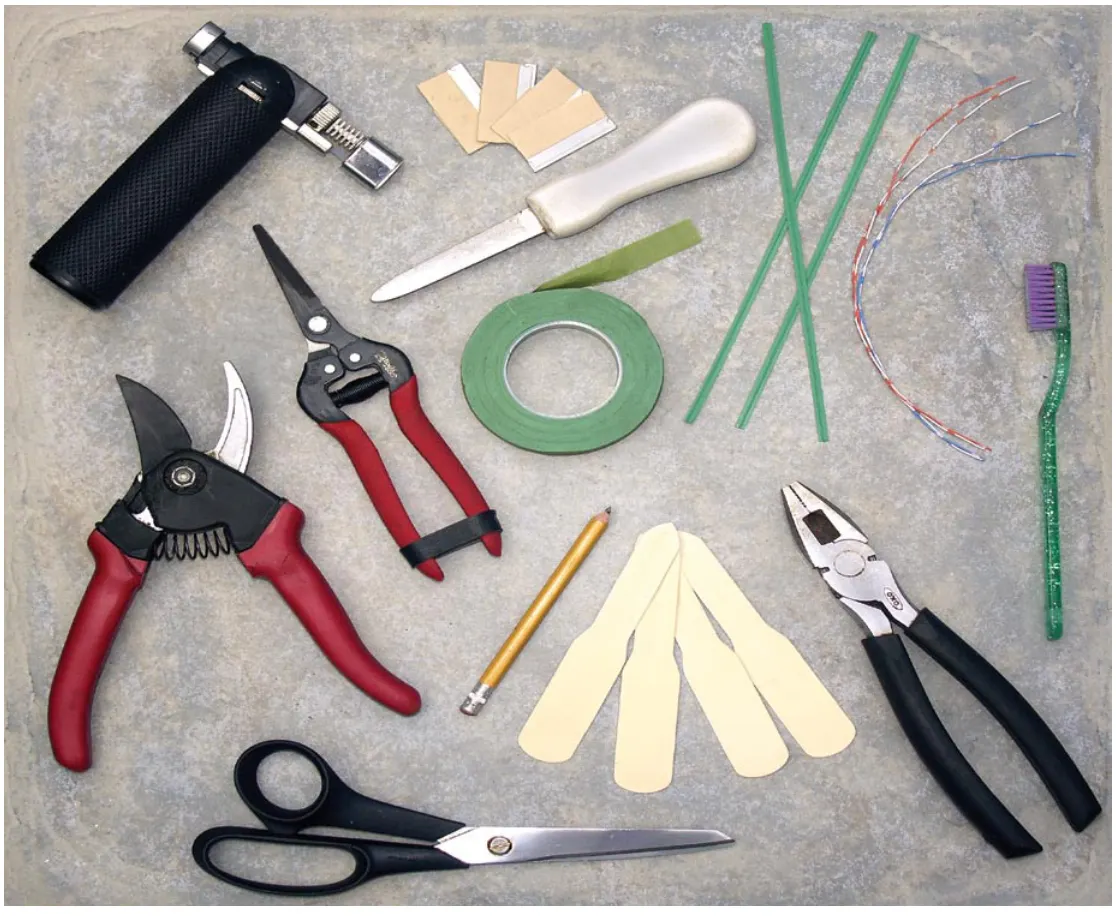
Ties and clips are essential ancillary items to orchid growing and potting. We tie pseudobulbs together to make a neater arrangement when repotting, or we may tie a plant or inflorescence to a stake to stabilize it. Plants can be tied to mounts using almost any material, including monofilament fishing line or old pantyhose cut into strips. A basic selection of fasteners would include plastic ribbon ties, twist ties, telephone wire, plastic “dragonfly” clips and perhaps some monofilament or twine.
A retired soft toothbrush dipped in a little rubbing alcohol will do an excellent job of removing dried sheaths. In doing so, you also kill any insect pests that may be present. Always scrub softly and use special care when scrubbing around new leads and root tips; these parts are very fragile and damaging them can set the plant back.
Lineman’s pliers are a multipurpose tool for the orchid grower; they can cut through wire hangers or bend a rhizome clip to make it fit tighter. Their substantial weight allows them to be used as a sort of hammer. The angular jaws can enlarge the drainage holes in clay pots with ease or force that tight stake into position.
Help eliminate nameless orchids; always use a nametag. There are labels available in a style to suit almost any use, so keep a selection on hand. Most are plastic; however, aluminum tags are also available for extreme growing conditions, or where permanency is desired. Some provide spaces for bloom and repot information; some are available in colors so that you can code certain plants. Most simply slip into the pot while others tie on with wire or loops.
Over time, ink from nearly all felttip markers will fade under greenhouse conditions. For plastic name tags a graphite pencil is the only permanent solution.
Garden shears are indispensable to orchid growers. When repotting we use them to cut away old roots, dead leaves and anything else that needs cutting. Shears can be found in different styles but usually have straight “needle-nose” blades or curved blades. The straight blades are perfect for getting into tight areas to cut away old roots, whereas the curved blades will cut through thick rhizomes more easily. It’s a good idea to have several styles on the potting bench. Having several pairs also allows you continue working without having to stop between each plant to sterilize tools. A pair of utility scissors is also useful during a potting session to cut thin leaves and roots.
Bamboo and steel straight stakes can be inserted into the potting medium to provide additional support for a newly potted orchid. Ring stakes that fit around the whole plant are available as well as styles that slip over the edge of a clay pot. Stakes are essential to support the inflorescence of an orchid so that it displays in a more attractive fashion.
— Greg Allikas.